Prabhupada: I shall speak some verses from Bhagavad-gita, Second Chapter, in which the Supreme Personality of Godhead Krsna instructed. The beginning of instruction is the Second Chapter of Bhagavad-gita. So Arjuna, representing ourself, conditioned soul, covered with the material body and thinking in bodily conception of life... He was to fight with his brothers, nephews, grandfather, Bhismadeva, also teacher the military science, Dronacarya. In this way the business was not very palatable. Although he was forced to fight by the opposite party who were very near, thick and thin people, and he had to kill them, so it was not very satisfactory to him. Therefore he flatly denied to fight: "Krsna, I am not going to fight." He left his weapon, and then Krsna was surprised that "My friend, Arjuna, he is denying to fight in My presence."
So Sanjaya, the private secretary of Maharaja Dhrtarastra, he was relaying the message which was going on in the battle of Kuruksetra by higher process. Nowadays we have got experience of the television, but the another process, antar-drsti, that is also television. You can see the reflection of external activities within your heart, and you can explain. So Sanjaya, the private secretary of Maharaja Dhrtarastra, he explained that Arjuna was denying to fight. So,
tam tatha krpayavistam
asru-purnakuleksanam
visidantam idam vakyam
uvaca madhusudanah
[Bg. 2.1]
Madhusudana is Krsna's another name. So when Krsna saw that Arjuna is unnecessarily disturbed, then, tam tatha krpayavistam asru-purnakuleksanam [Bg. 2.1]. Asru-purna: his eyes was full with tears. "Krsna, I have to fight with my relatives." So he was crying, that "This is not very good business." So why he was crying? Krpayavistam: being merciful upon them. They were so cruel upon the Pandavas that they insulted their wife, they tricked how to take away their kingdom. All this injustice was done to them. Still, because Arjuna is a Vaisnava, a devotee, still, he was sympathetic: "No, no, let them do whatever they have done, but I am not going to kill them." So krpayavistam asru-purnakuleksanam [Bg. 2.1], visidantam. Bhagavan uvaca.
Then, after Arjuna being silent not to fight, then Bhagavan... Krsna is Bhagavan. Bhagavan means the Supreme Personality of Godhead, full with all opulences. That is called Bhagavan. Generally in India we speak, bhagyavan. Bhagyavan means one who has got opulences. So Bhagavan means one who is full in opulences -- in wealth, in strength, in influence, in beauty, in education, in renunciation. In these six ways, when one is opulent fully then he can be called Bhagavan. Partially, if one is very opulent, sometimes he is also called Bhagavan, but real Bhagavan, according to sastra, is Krsna. Krsnas tu bhagavan svayam. Others, they may possess some of the opulences, not in full, partially. Just like Narada Muni or Lord Brahma, Lord Siva. They are also sometimes called Bhagavan. But real Bhagavan is Krsna. Krsnas tu bhagavan svayam. Ete camsa-kalah pumsah krsnas tu bhagavan svayam [SB 1.3.28]. So here Bhagavan, the Supreme Person, Krsna. Krsna means, as Krsna says in the Bhagavad-gita, mattah parataram nanyat kincid asti dhananjaya: [Bg. 7.7] "There is no more superior person or element more than Me." And when Arjuna understood Krsna he also admitted, param brahma param dhama pavitram paramam bhavan [Bg. 10.12].
So Krsna is the Supreme Personality of Godhead. He is the origin of Brahman. He is the origin of Paramatma. Brahmeti paramatmeti bhagavan iti sabdyate [SB 1.2.11]. The Absolute Truth is experienced in three ways -- Brahman, Paramatma and Bhagavan. So Bhagavan is the last word of the Absolute Truth, the Supreme Person. Therefore Vyasadeva has purposefully written here, "sri bhagavan uvaca." Bhagavan uvaca mean you cannot exceed the Supreme Person. Nobody can be equal to the Supreme Person; nobody can be more than the Supreme Person. Everyone should be under the Supreme Person. That is the meaning of Bhagavan. So Bhagavan said,
kutas tva kasmalam idam
visame samupasthitam
anarya-justam asvargyam
akirti-karam arjuna
[Bg. 2.2]
"My dear Arjuna, you are My friend, personal friend, and you are proposing this, which is befitting to the anarya." Anarya-justam: "This is not for the Aryan. You are ksatriya, you are meant for fighting for justice, and you are denying to fight? Oh, this is not good." Anarya-justam: "This kind of proposal, cowardice, can be proposed by the anarya." Arya means the advanced. One who is advanced in knowledge, in civilization, they are called arya, Aryan civilization. So in the Aryan civilization there are four divisions to maintain the society in the correct balance.
That is also stated in the Bhagavad-gita. Catur-varnyam maya srstam guna-karma-vibhagasah [Bg. 4.13]. The society must be divided into four classes of men. The first-class means most intelligent class of men. They should be trained up as brahmana. Samo damah satyam saucam titiksa arjavam jnanam vijnanam astikyam brahma-karma svabhava-jam. So this is the beginning of civilization, not that all sudras as it is now in this age. Kalau sudra-sambhavah. Kali-yuga, there is no training how to qualify a section of person to become first-class brahmana. That training is not there, neither ksatriya, neither pure vaisya class. We are proud of our business, vaisya, but vaisya means krsi-go-raksya-vanijyam vaisya-karma svabhava-jam [Bg. 18.44]. Vaisya means they should take care of the cows, cow protection, go-raksya. Why go-raksya? Why not other animal raksya? Krsna has not said "animal raksya" or "janawal-(?) raksya." Go-raksya. The cow is very, very important animal. If you want to advance your spiritual consciousness, then you must have sufficient milk and sufficient grains. That is civilization.
Therefore it is the duty of the vaisyas to produce food grain. Annad bhavanti bhutani [Bg. 3.14]. Annad. In the society, if you have got sufficient anna, both the animals and the man, they will be happy. These are the instruction in the Bhagavad-gita, everything practical. If we follow Bhagavad-gita from all angles of vision -- social, political, economical, religious, cultural -- you will be perfect. This is Bhagavad-gita. We are therefore taken up this mission, to preach Bhagavad-gita as it is to solve all the problems of the world. That is Aryan civilization. Aryan civilization means following the principles of Bhagavad-gita.
So here Krsna is addressing Arjuna, anarya: "Non-Aryan. You are ksatriya. Your service is now required to fight with persons who have created injustice. So what is this, that you are denying to fight?" Anarya justam. And asvargyam. Asvargyam means "By denying your duty you cannot be elevated in your next life or you cannot be elevated in the higher planetary system." For a ksatriya, it is the duty of the ksatriya to fight and lay down his life. Then he is promoted to the higher planetary system. That is the shastric injunction. If he becomes victorious, then he enjoys this material world, and if he dies, he is promoted to heaven. These things are there. Therefore Krsna is advising Arjuna, asvargyam: "If you deny to fight, then you will be refused to enter in the higher planetary system." Akirti-karam. "And you are known as a great fighter, great soldier and My friend, and this will be going against your reputation. Don't do this." Then He says,
klaibyam ma sma gamah partha
naitat tvayy upapadyate
ksudram hrdaya-daurbalyam
tvaktvottistha parantapa
[Bg. 2.3]
"My dear friend, parantapa..." Parantapa means one who gives trouble to the enemies. This is the material world. A ksatriya cannot behave like a brahmana, to excuse. Brahmana business is to excuse. Ksama-rupa-tapasvinah. Those who are tapasvi, they can excuse, but those who are in the governmental post, to make justice, there is no question of excuse. Life for life. "You have killed one man; you must be killed." This is justice. A brahmana, he may excuse, "All right, you have killed my man. Never mind. I excuse you." That is a brahmana's business. But a ksatriya, the government, the ruling power, he cannot do so. It is his mercy. It is the government's mercy when a murderer is hanged. That is the injunction in the Manu-samhita. "So parantapa, you are ksatriya. Your business is to punish the unjust." Ksudram hrdaya-daurbalyam: "For a ksatriya this kind of poor-heartedness, that I shall not fight...' Give it up. Don't indulge in such thing."
Then Arjuna replied,
katham bhismam aham sankhye
dronam ca madhusudana
isubhih pratiyotsyami
pujarhav arisudana
[Bg. 2.4]
He is addressing Krsna as arisudana, the killer of the enemies. He says, "But in my case, I have to fight with Bhisma, Dronacarya. They are my well-wisher, and how can I kill them? It is my duty to offer my respect, touching their feet, and You are enticing me to pierce their body with arrow? So, of course, You have killed so many enemies, but You have killed enemies. Why You are inducing me to kill my grandfather and my teacher?" Of course, Arjuna, also intelligent. He replied that "You cannot accuse me as anarya. This is the consideration. Therefore I am hesitating to fight." Then he says,
gurun ahatva hi mahanubhavan
sreyo bhoktum bhaiksyam apiha loke
hatvartha-kamams tu gurun ihaiva
bhunjiya bhogan rudhira-pradigdhan
[Bg. 2.5]
"They are not only my grandfather. They are guru. And mahanubhavan, very great personality, Bhismadeva, Dronacarya. So if I kill them and if I live prosperously, taking the kingdom, do You think it is all right that I live on the blood of my guru and great personalities? Do You think it is all right?" Of course, he says,
na caitad vidmah kataran no gariyo
yad va jayema yadi va no jayeyuh
yan eva hatva na jijivisamas
te 'vasthitah pramukhe dhartarastrah
[Bg. 2.6]
"Krsna, actually I am puzzled. It is my duty to fight, but now I am puzzled whether I shall fight or not fight because, after all, the other side, they are my relatives, family members, dhartarastrah. Dhrtarastra is my elder brother of my father, and his sons they are my cousin-brothers. So I am puzzled whether I shall fight." He plainly explained his position that "Not that I have become anarya. I have got sufficient strength. I can fight, but I am puzzled whether I shall fight in this case or not."
Then he submits,
karpanya-dosopahata-svabhavah
prcchami tvam dharma-sammudha-cetah
yac chreyah syan niscitam bruhi tan me
sisyas te 'ham sadhi mam tvam prapannam
[Bg. 2.7]
Then Arjuna decided to accept Krsna as his guru. He... Sisyas te 'ham: "I become your disciple." To become disciple means no more argument. When we talk friendly there is argument, counterargument. But when there is order from guru there is no more argument. Therefore Arjuna says that karpanya-dosopahata-svabhavah: "Actually my behavior should be exactly like a ksatriya, to fight for the just cause, but in this case I am denying. Therefore I am krpana." Krpana means one who does not properly use his position. One man is very rich, but he does not use his money, simply sees the money. He is called krpana. Similarly, Arjuna is powerful, he can fight, he is a ksatriya, but he is denying his ability. Therefore he is thinking that "I have become krpana, miser. Although I have got strength, I am denying to fight." "Although I have got money, I do not spend." These are called krpana. So karpanya-dosopahata: "Now I am infected with karpanya-dosa." Karpanya-dosopahata-svabhavah.
So when we become puzzled with these material affairs, what to do -- to do or not to do, this is the example -- at that time we must approach a guru. That is the instruction here, we see. Prcchami tvam dharma-sammudha-cetah. When we are bewildered, we do not distinguish what is religious and what is not religious, do not use our position properly. That is karpanya-dosopahata-svabhavah [Bg. 2.7]. At that time there is need of guru. That is the Vedic instruction. Tad-vijnanartham sa gurum evabhigacchet srotriyam brahma-nistham [MU 1.2.12]. This is the duty. This is civilization, that we are meeting with so many problems of life. That is natural. In this material world the material world is problems of life. Padam padam yad vipadam. Material world means in every step there is danger. That is material world.
So therefore we should take guide from guru, from the teacher, from the spiritual master how to make progress, because this... That will be explained later on, that the goal of our life, at least in this human form of life, in the Aryan civilization, the goal of life is to understand our constitutional position, "What I am. What I am." If we do not understand "What I am," then I am equal to the cats and dogs. The dogs, cats, they do not know. They think that they are the body. That will be explained. So in such condition of life, when we are puzzled... Actually we are puzzled every moment. Therefore it is necessary one should approach to a proper guru. Now Arjuna is approaching Krsna, the first-class guru. First-class guru. Guru means the Supreme Lord. He is guru of everyone, parama-guru. So anyone who represents Krsna, he is also guru.
That will be explained in the Fourth Chapter. Evam parampara-praptam imam rajarsayo viduh [Bg. 4.2]. So Krsna is showing example, where we should offer our surrender and accept guru. Here is Krsna. So you have to accept Krsna or His representative as guru. Then your problems will be solved. Otherwise it is not possible, because he can say what is good for you, what is bad for you. He is asking, yac chreyah syan niscitam bruhi tat. Niscitam. If you want advice, instruction, niscitam, which is without any doubt, without any illusion, without any mistake, without any cheating, that is called niscitam. That you can get from Krsna or His representative. You cannot get right information from the imperfect person or a cheater. That is not right instruction. Nowadays it has become a fashion; everyone is becoming guru and he is giving his own opinion, "I think," "In my opinion." That is not guru. Guru means he should give evidences from sastra. Yah sastra-vidhim utsrjya vartate kama-karatah: "Anyone who does not give evidences, proof, from the sastra, then" na siddhim sa avapnoti, "he does not get at any time success," na sukham, "neither any happiness in this material world," na param gatim, "and what to speak of elevation in the next life." These are the injunction.
So we must select guru. Here it is, example, Arjuna. He's accepting Krsna as guru. Why he is accepting? Because, he says,
na hi prapasyami mamapanudyad
yac chokam ucchosanam indriyanam
avapya bhumav asapatnam rddham
rajyam suranam api cadhipatyam
[Bg. 2.8]
So he has selected that the right person, guru, and he said that "Unless I hear from You what is right and wrong, I cannot decide whether I shall fight or I shall not fight. Which way is better for me I cannot understand." In this way,
evam uktva hrsikesam
gudakesah parantapah
na yotsya iti govindam
uktva tusnim babhuva ha
[Bg. 2.9]
"After addressing Krsna that You give me the right direction; otherwise I am not going to fight,' he left his weapon and became silent."
tam uvaca hrsikesah
prahasann iva bharata
senayor ubhayor madhye
visidantam idam vacah
[Bg. 2.10]
Now, Krsna took the position of guru, and He began to instruct. Tam uvaca hrsikesah. Hrsikesa..., Krsna's another name is Hrsikesa. Hrsikesa means hrsika isa. Hrsika means the senses, and isa, the master. Therefore Krsna is the master of our senses, everyone's senses. That will be explained in the Thirteenth Chapter, that ksetra-jnam capi mam viddhi sarva-ksetresu bharata [Bg. 13.3].
In this body there are two living entities. One is myself, the individual soul, atma; and the other is Krsna, Paramatma. Isvarah sarva-bhutanam hrd-dese arjuna tisthati [Bg. 18.61]. So actually the proprietor is Paramatma. I am given the chance to use it, so my senses, so-called my senses, that is not my senses. I have not created my hand. The hand is created by God, or by Krsna, through the agency of this material nature, and I am given the hand to use it for my purpose, for my eating, for my collecting. But actually it is not my hand. Otherwise, when this hand becomes paralyzed, I am claiming, "my hand" -- I cannot use it because the power of the hand is withdrawn by the proprietor. Just like in a house, rented house, you are living. If the proprietor of the house, landlord, eject you, you cannot live there. You cannot use it. Similarly, we can use this body as long as the real proprietor of the body, Hrsikesa, allows me to stay here. Therefore Krsna's name is Hrsikesa. And this Krsna consciousness movement means that we have accepted the senses from Krsna. It should be used for Krsna. Instead of using it for Krsna, we are using it for our sense gratification. This is our miserable condition of life. Just like you are living in a place for which you have to pay rent, but if you don't pay rent -- you think that it is your property -- then there is trouble. Similarly, Hrsikesa means the real proprietor is Krsna. I have been given this property. That is stated in the Bhagavad-gita.
isvarah sarva-bhutanam
hrd-dese 'rjuna tisthati
bhramayan sarva-bhutani
yantrarudhani mayaya
[Bg. 18.61]
Yantra: it is a machine. This machine has been given by Krsna to me because I desired that "If I get a machine like a human body, then I can enjoy like this." So Krsna fulfills your desire: "All right." And if I think, "If I get a machine in which I can directly suck blood of other animal," "All right," Krsna says, "you take the machine of a tiger's body and use it." So this is going on. Therefore His name is Hrsikesa. And when we understand properly that "I am not the proprietor of this body. Krsna is the proprietor of the body. I wanted a certain type of body to use it for my sense gratification. He has given it and I am not happy. Therefore I shall learn how to use this machine for the proprietor," this is called bhakti. Hrsikena hrsikesa-sevanam bhaktir ucyate [Cc. Madhya 19.170]. Because Krsna is the proprietor of the senses -- He is the proprietor of this body -- so when this body will be utilized for Krsna's service, that is our perfection of life. Hrsikena hrsikesa-sevanam bhaktir ucyate.
sarvopadhi-vinirmuktam
tat-paratvena nirmalam
hrsikena hrsikesa-
sevanam bhaktir ucyate
[Cc. Madhya 19.170]
If you want the definition of bhakti, the bhakti means to use the things for the proprietor. That is right use. If somebody use for another purpose, that is misuse. So bhakti means, when things are used properly, that is called bhakti. Now we are thinking that this machine, this body, "I am born in India, so it is Indian machine. It should be utilized for India's profit." Another person is thinking, "This machine, it is gotten from America, so it should be used for America." That is going on in the name of nationality or communism, or society or friendship and this and so on. We have invented so many "isms," but they are all misuse because actually the machine does not belong to the American or the Indian or the African. The machine belongs to Krsna. So this is misuse. So when we understand that we are misusing this machine improperly, that is called pure machine. That is called pure understanding, or Krsna consciousness.
Sarvopadhi-vinirmuktam [Cc. Madhya 19.170]. "I am not American. I am not Indian. I am not brahmana. I am not ksatriya. I am not human being." Aham brahmasmi: "I am Brahman." Not the Supreme Brahman, but part and parcel of Brahman. Supreme Brahman is Krsna, Parabrahman. He is addressed as Parabrahman. So we are part and parcel of Brahman. Therefore we are Brahman. So we have to realize this position. Aham brahmasmi: "I am Brahman." I am not this machine. I am put into this machine, but because the machine is gotten either from America or from India or from heaven or from hell, I am designating this machine as American machine or Indian machine. Actually this machine belongs to Krsna, and it should be used for Krsna. Therefore the definition of bhakti means hrsikena hrsikesa-sevanam bhaktir ucyate [Cc. Madhya 19.170]. This is bhakti.
So Krsna, now He has taken the position of teacher. Now no more friendly talking because Arjuna has accepted Him as the teacher. So He's the teacher. It is the duty of the teacher to punish or to chastise the disciple when he is wrongly going on. That is the duty. So first teaching of Krsna, because Arjuna has accepted His leadership, His teachership, His instruction, accepted that he will follow His instruction, so first instruction is asocyan anvasocas tvam prajna-vadams ca bhasase: [Bg. 2.11] "You rascal, you are rascal. You are talking like a very learned man that How shall I kill my, this grandfather? How shall I kill my brother, this and so on?' This is all bodily concept of life. You are talking on the bodily platform." So what is this body? It is to be neglected? "Yes." Asocyan anvasocas tvam: "It is not to be lamented."
asocyan anvasocas tvam
prajna-vadams ca bhasase
gatasun agatasums ca
nanusocanti panditah
[Bg. 2.11]
Pandita means one who knows that "I am not this body." That is pandita. The body is a lump of matter, so what is the value of lump of matter? Either while it is moving or while it is not moving, it is a lump of matter. Suppose we are now moving with this body with nice coat, pant, hat. That's all right. But what it is? It is a lump of matter. Either coat, pant, or these bones and the skin and the blood and the stool and urine, whatever this body is composed of, it is all material. And when the living entity goes away from this body, the same lump of matter... Does it change? So we are not lamenting at the present moment because it is moving. And as soon as the movement is stopped, I say, "Oh, my father has gone. My son has gone," and we lament.
So actually the body is the same. The same body is lying here as dead body, whom we are lamenting, "my father," but you have never seen your father. You have seen only the coats and pants and the body. That is your education. Therefore Krsna says, "Arjuna, you are thinking on terms of this coats and pants and bones and muscles and urine and stool. Therefore you are rascal number one." This is the first instruction, asocyan anvasocas tvam prajna... [Bg. 2.11]. "Do any gentlemen lament for this torn-up cloth, bones and skins and urine and stool? Does any sane man lament?" This is the first instruction. So asocyan anvasocas tvam prajna-vadams ca bhasase: "You are talking just like a very learned man to argue with Me, but you are fool number one because" -- gatasun agatasums ca nanusocanti panditah -- "this is not the business of the pandita."
So this is not the position of Arjuna only. The whole material civilization, the whole population of the whole world, they are like this asocyan anvasocas tvam [Bg. 2.11]. When the body is living, when the body is moving, they are busy how to make the body comfort. And when the body is not moving they are lamenting. That is the business. Therefore brahma-bhutah prasannatma na socati na kanksati [Bg. 18.54]. The..., our business is, the material civilization means, socati kanksati, two business. Kanksati means desiring. While the body is moving we are desiring, making plan: "I want this. I want this. My son requires this. My nation requires this. My community requires this." This is, means, kanksati, desiring to possess this, possess... And when the body is lost, then socati: "Oh, my father is lost. My brother is lost. My son is lost." Two business. So long there is no spiritual knowledge, we have got on the material conception of body two business -- socati, kanksati: desiring for things which we do not possess and lamenting for things which we have lost. This is our two business. But if you become self-realized, if you become aware actually what you are, then na socati na kanksati.
brahma-bhutah prasannatma
na socati na kanksati
samah sarvesu bhutesu
mad-bhaktim labhate param
[Bg. 18.54]
This is the business. So our this Krsna consciousness movement is trying to educate people to give up this bodily concept of life. This is the sum and substance of this movement. And unless we come to understanding that "I am not this body; I am a spirit soul. My aim of life is missing," then we remain cats and dogs.
yasyatma-buddhih kunape tri-dhatuke
sva-dhih kalatradisu bhauma ijya-dhih
yat-tirtha-buddhih salile na karhicij
janesv abhijnesu sa eva go-kharah
[SB 10.84.13]
Anyone who is leading his life on the bodily concept of life, he is no better than the dogs and hogs. So in order to stop this civilization of dogs and hogs, the Krsna consciousness movement is essential. Krsna consciousness means to take instruction from Krsna. This is the first instruction. Asocyan anvasocas tvam prajna-vadams ca bhasase [Bg. 2.11]. So gradually He will give instruction.
So it is our request that you try to study Bhagavad-gita as it is. Don't try to distort it by your so-called education. Try to understand Krsna as He is saying. Then you will be benefited. Your life will be successful. Thank you very much. Hare Krsna. [break]
Pusta-krsna: What is the meaning of sac-cid-ananda?
Prabhupada: That is spirit soul. Sat means eternal, and cit means knowledge, and ananda means bliss. So if we study ourself, this body is not eternal. Sat means eternal. So if you study this body... In the Bhagavad-gita you will find, antavanta ime deha nityasyoktah saririnah [Bg. 2.18]. This body is antavat; it will perish. Therefore it is not sat. Sat means eternal, and the body is not eternal. Therefore it is very difficult to understand what is sat because we have no education, no experience. Everything is annihilated, destroyed, anything material. So actually we have no experience what is sat.
So... But Vedic instruction is sad gama asato ma: "Don't remain in asat, noneternal. Come to the platform of eternity." Sad gama asato ma. So that is our mission of life. The human form of life is distinct from the cats and dogs because if you instruct to the cats and dogs what is sat and what is asat, it is impossible for them to understand. It is not possible. Therefore Vedic instruction is asato ma: "Don't remain cats and dogs in the human form only. You come to the platform of eternity." Asato ma sad gama. So we must try what is eternal. So far in the present condition, as this material condition, we do not know what is actually eternal because our body is not eternal.
Therefore the first instruction is that "You are lamenting on the body which is not eternal, but you are eternal. Your business is to understand the eternal." That is called sat. And cit. Cit means knowledge. At the present moment we are all in ignorance. We do not know what is the next step, "Whether I am going to live or to die." Everything in ignorance. Therefore this body is also not cit. It is full of ignorance. Then sat, cit and ananda, that we have got experience... Where is ananda? Ananda means blissfulness, joyfulness. There cannot be any joyfulness in this body. There are three kinds of miserable condition of material life: adhyatmika, adhibhautika, adhidaivika. So either these three or one or two is always there. Adhyatmika means miserable condition on account of the body and mind.
So wherever we go, the body is there. So even if I am very opulent materially with wealth, we are getting experience that even the most rich, richest man in the society, he is committing suicide. Why? He has got every resources to enjoy. Why he is committing suicide? That means there is also no ananda, even you possess the material things. So there is no question of sac-cid-ananda in this material condition of life. If you understand what is spiritual life and if you practice how to come to the spiritual life, spiritual platform, as Krsna is, then we can become equal with Krsna, sac-cid-ananda. Otherwise we are in ignorance. This body is not sac-cid-ananda. (end)
>>> Ref. VedaBase => Bhagavad-gita 2.1-11 -- Johannesburg, October 17, 1975
Saturday, July 15, 2006


Wednesday, June 21, 2006
Material Civilization Is Wrongly Directed To Sense Gratification
kamasya nendriya-pritirlabho
jiveta yavatajivasya
tattva-jijnasanartho yas ceha
TRANSLATION
Life’s desires should never be directed toward sense gratification. One should desire only a healthy life, or self-preservation, since a human being is meant for inquiry about the Absolute Truth. Nothing else should be the goal of one’s works.
PURPORT
The completely bewildered material civilization is wrongly directed towards the fulfillment of desires in sense gratification. In such civilization, in all spheres of life, the ultimate end is sense gratification. In politics, social service, altruism, philanthropy and ultimately in religion or even in salvation, the very same tint of sense gratification is ever-increasingly predominant. In the political field the leaders of men fight with one another to fulfill their personal sense gratification.
The voters adore the so-called leaders only when they promise sense gratification. As soon as the voters are dissatisfied in their own sense satisfaction, they dethrone the leaders, The leaders must always disappoint the voters by not satisfying their senses. The same is applicable in all other fields; no one is serious about the problems of life. Even those who are on the path of salvation desire to become one with the Absolute Truth and desire to commit spiritual suicide for sense gratification. But the Bhagavatam says that one should not live for sense gratification.
One should satisfy the senses only insomuch as required for self-preservation, and not for sense gratification. Because the body is made of senses, which also require a certain amount of satisfaction, there are regulative directions for satisfaction of such senses. But the senses are not meant for unrestricted enjoyment. For example, marriage or the combination of a man with a woman is necessary for progeny, but it is not meant for sense enjoyment. In the absence of voluntary restraint, there is propaganda for family planning, but foolish men do not know that family planning is automatically executed as soon as there is search after the Absolute Truth.
Seekers of the Absolute Truth are never allured by unnecessary engagements in sense gratification because the serious students seeking the Absolute Truth are always overwhelmed with the work of researching the Truth. In every sphere of life, therefore, the ultimate end must be seeking after the Absolute Truth, and that sort of engagement will make one happy because he will be less engaged in varieties of sense gratification.
[Srimad Bhagavatam 1.2.10]
Sunday, June 18, 2006
The Supreme Controller Is Krsna

Prabhupada: This is the secret. People are trying to bring in peace and prosperity in the world by so many activities—philanthropism, altruism, nationalism, socialism. And so-called religion also, they are trying to bring in.
The whole idea is the human society should remain in peace and prosperity. And the vivid example is the United Nations in your country. America invited all nations that “Let us form a community of United Nations,” but the America herself is fighting. You see? Because the idea was there to unite, but they do not know the basic principle, how to unite. That is the defect. There is a church in the United Nations, and we tried to get a room there for making our propaganda. The church unity denied to give us. So their crippled mind is not expanded. Sa mahatma... Mahatma means broad-minded. Su-durlabhah.
So mahatma, unless one becomes nonenvious, mahatma, there is no question of so-called unity or fraternity. These are all false propaganda. It is not possible. But they will stick to that proposition, that “We have got this...” For the last twenty years... Why twenty years? More than twenty years. When this United Nations was started?
Visnujana: Even... Right after World War One they began.
Prabhupada: Yes. Sometime 1948, ’47. Hm? Or earlier. Anyway, it is more than twenty-five, twenty years. But what they have done? The people are still fighting. So here is the..., that we have to dovetail our service, we have to make Krsna center. The Communists also, they tried to make by making the state as center. So that is also failure. Or the United Nations also. I do not know what is their center. Their center is politics, that’s all.So in this way there cannot be complete harmony. Complete harmony will be possible only when you bring in Krsna. That will be explained in the next verse. Isavasyam idam sarvam.
Unless you bring Krsna, or isa... Isa means the supreme controller. He is actually controlling. Isa. Isa means the controller. So there is a supreme controller. We see in the, in our experience, that some of the objectives are living and some of them are not living. Animate or inanimate—these two things we see in our experience. But above this animate and inanimate there is supreme animate. That supreme animate is called isa. Isa or isvara means controller.
So there are many isvaras, or controllers, but the supreme controller is Krsna. Isvarah paramah krsnah [Bs. 5.1]. There are many controllers. Some of you are also controller, in charge of some department. Similarly, controller over controller, controller over controller—there are many. And go up to Brahma. The first creature within this universe is supposed to be the controller of this universe. But above him, there is another controller. That is Krsna. Yasyajnaya bhramati sambhrta-kala-cakro. The material scientists, they are finding out the sun is the cause of all material manifestation. Actually, that’s a fact. But what is the sun?
The sun is also being controlled. That is stated in the Brahma-samhita: Yac-caksur esa savita sakala-grahanam raja samasta-sura-murtir asesa-tejah. Yac-caksur esa savita. Savita means the sun is the eye of the Supreme Lord, seeing everything. You cannot hide anything. The sun, the moon, the day and the night, everyone is seeing your activities. And besides that, the Lord is within you also. So where you shall hide your sinful activities? You cannot hide anything. You can hide from the state laws, but you cannot hide yourself from God’s law. That is not possible. Isavasyam idam sarvam.
Everywhere He is present. So, yac-caksur esa savita sakala-grahanam. Actually, the sun is the eye of all the planets. Now we are in this planet, earthly planet. So actually our eyes are the sun. When there is sunrise, then we can see, “Oh, here it is, here it is, here it is.” So, yac-caksur esa savita sakala-grahanam. All the planetary systems that are existing within this universe, the sun is the eye because he is the eye of the Supreme Lord. Yac-caksur esa savita sakala-grahanam raja. It is the king of all planets. Raja samasta-sura-murtir asesa-tejah. Asesa-tejah, unlimited temperature. Unlimited temperature. Asesa-tejah. And it is so powerful and so important, but what is his position? Yasyajnaya bhramati sambhrta-kala-cakro. Under the direction of the Supreme, it is rotating in its own orbit.
The sun has its own orbit. Just like this earth has its own orbit, similarly, sun, sambhrta-kala-cakro, yasyajnaya... The sun cannot go beyond that orbit. Just like we go to the sea. The order is, “My dear Pacific Ocean, you may be very great, but you cannot come beyond this.” We are walking daily on the beach. Just four feet away, the water is there, but it cannot touch because the order is, “No, you cannot come. Up to this, that’s all.”
So everyone is ... Just like you have seen the horse is controlled by the driver, similarly, all of us are being controlled. So we should remain controlled. That is life. We should not declare that “No. I don’t want to be controlled.” Then you’ll fall down immediately. If you remain in your position, being controlled, being predominated... Don’t try to be predominator. Oh, then immediately fall down, because you are not predominator. It is a false claim that “I want to predominate. I am God. I am predominator. I am this. I am that.” These are all rascaldom. Simply you remain yourself predominated. Agree to be controlled by Krsna, and your life is successful.Thank you very much. (end)
Lecture Excerpt--Los Angeles, June 7, 1972
Tuesday, June 06, 2006
Chanting With Krsna
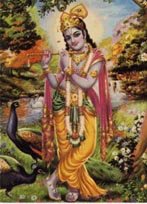
. . .when you chant Krsna, Hare Krsna, actually the fact is Krsna is dancing on your tongue by sound vibration. Krsna is not away. It is stated in the scriptures, naham tisthami vaikunthe. He is addressing Narada, Narada, a great devotee of Krsna. He is explaining to Narada, naham tisthami vaikunthe yoginam hrdayesu ca. The yogis, the mystic yogis, they try to find out the Supersoul within themself. That is the yoga system. Yoga, actual yoga system, is to concentrate the mind, to focus the mind on the Supersoul. That is yoga system. So Krsna says that naham tisthami vaikunthe. In the scriptures we find that kingdom of God, that is called Vaikuntha. Vaikuntha means vigata-kuntha yatra. Kuntha means anxieties. The place where there is no anxieties, that is called Vaikuntha. So Krsna says that naham tisthami vaikunthe yoginam hrdayesu ca: “My dear Narada, do not think that I am staying in the Vaikuntha, in the kingdom of God only, or in the heart of the yogis only. No.” Tat tat tisthami narada yatra gayanti mad-bhaktah: “Wherever My devotees sing or chant the glories of Me, I stand there. I go there.”
[Bhagavad-gita 4.20-24--New York, August 9, 1966]
Saturday, June 03, 2006
Knowledge Beyond Samsara

Krsna specifically states that this process of Krsna consciousness is susukham, very pleasant and easy to practice. Indeed, the devotional process is very pleasant; we melodiously sing with instruments, and someone will listen and also join (sravanam kirtanam).
Of course the music should be in relation with the Supreme Lord, in glorification of Him. Hearing Bhagavad-gita is also part of devotional service, and in addition to hearing it one should be eager to apply it in his life. Krsna consciousness is a science and should not be accepted blindly. There are nine processes of devotional service recommended (hearing, chanting, remembering, worshiping, praying, serving, engaging as a servitor of the Lord, establishing friendly relations with the Lord, offering everything to the Lord).
These are all easy to practice and should be joyfully performed.Of course if one thinks that Bhagavad-gita and the Hare Krsna mantra are part of the Hindu system and doesn’t want to accept them because of this, he can nonetheless attend the Christian church and sing there. There is no difference between this process and that process; the point is whatever process one follows, he must become God conscious.
God is neither Moslem nor Hindu nor Christian—He is God. Nor are we to be considered Hindu, Moslem or Christian. These are bodily designations. We are all pure spirit, part and parcel of the Supreme. God is pavitram, pure, and we are also pure. Somehow or other, however, we have fallen into this material ocean, and as the waves toss, we suffer. Actually we have nothing to do with the tossing waves of material miseries. We must simply pray, “Krsna, please pick me up.” As soon as we forget Krsna, the ocean of illusion is there, and it at once captures us.
The chanting of Hare Krsna is most important in order to escape from this ocean. Hare Krsna, Hare Krsna, Krsna Krsna, Hare Hare/ Hare Rama, Hare Rama, Rama Rama, Hare Hare is a sound (sabda) that is non-different from Krsna. The sound Krsna and the original Krsna are the same. When we chant Hare Krsna and dance, Krsna is also dancing with us. Of course we may say, “Well, I do not see Him,” but why do we put so much stress on seeing? Why not hearing? Seeing, tasting, smelling, touching, and hearing are all instruments for experience and knowledge. Why do we put such exclusive stress on seeing? A devotee does not wish to see Krsna; he is satisfied by simply hearing of Krsna. Seeing may eventually be there, but hearing should not be considered any less important.
There are things which we hear but do not see—the wind may be whistling past our ears, and we can hear it, but there is no possibility of seeing the wind. Since hearing is no less an important experience or valid one than seeing, we can hear Krsna and realize His presence through sound. Sri Krsna Himself says, “I am not there in My abode, or in the heart of the meditating yogi but where my pure devotees are singing.” We can feel the presence of Krsna as we actually make progress.It is not that we should simply take things from Krsna and offer Him nothing. Everyone is taking something from God, so why not give something? We are taking from Krsna so much light, air, food, water and so on. Unless these resources are supplied by Krsna, no one can live. Is it love to simply keep taking and taking and taking without ever offering anything in return?
Love means taking and giving also. If we just take from someone and give him nothing in return, that is not love—it is exploitation. It is not that we should just continue eating without ever offering anything to Krsna. In Bhagavad-gita Krsna says:patram puspam phalam toyamyo me bhaktya prayacchatitad aham bhakty-upahrtamasnami prayatatmanahyat karosi yad asnasiyaj juhosi dadasi yatyat tapasyasi kaunteyatat kurusva mad arpanam“If one offers Me with love and devotion a leaf, a flower, fruit or water, I will accept it. O son of Kunti, all that you do, all that you eat, all that you offer and give away, as well as all austerities that you perform, should be done as an offering unto Me.” (Bg. 9.26–27)
In addition to giving and receiving, in the execution of devotional service one has to submit to Krsna whatever distress or confidential problem he has. He should say, “Krsna, I am suffering in this way. I have fallen in this tossing ocean of material illusion. Kindly pick me up. I understand now that am simply put here, as if thrown into the Atlantic Ocean. I may not in any way identify with the Atlantic Ocean, but I am subject to the tossing of the ocean. Actually I am a spiritual spark, a fragmental part of You.”
To our misfortune, we try to identify with this ocean and stop its tossing. We must not try to stop the tossing. It is not possible. In any case, the tossing will go on, for that is the law of nature. Only the foolish try to adjust to this world; the real problem is how to get out of it. Those who do attempt to adjust and who never turn to Krsna are continually subject to transmigration in the ocean of birth and death.asraddadhanah purusadharmasyasya parantapaaprapya mam nivartantemrtyu-samsara-vartmani“Those who are not faithful on the path of devotional service cannot attain Me, O conqueror of foes, but return to birth and death in this material world.” (Bg. 9.3)
By definition, religion is that which connects us with God. If it is not capable of connecting us with God, it is no religion. Religion means searching for God, understanding God and establishing a relationship with God. This is religion. Those who are engaged in devotional service are acting for Krsna or God, and since in this way there is connection with God, Krsna consciousness is a religion.It is not possible to manufacture a religion.
A true religion must come from an authorized source, and that source is either God or His representative. Religion has been called the law of God. It is not possible for a person to manufacture a State law. The law is there, and it is given by the State. One may create some bylaws for his own society, but these laws must be sanctioned by the law of the State. Similarly, if we wish to make some principle of religion, it must be sanctioned by the Vedic authority.
Bhagavad-gita is also religion. Great authorities like Ramanujacarya, Madhvacarya, Visnusvami, Lord Caitanya, Sankaracarya, and so many others have accepted Bhagavad-gita as the supreme principle of religion and Krsna as the Supreme Personality of Godhead. There is no doubt about it. In the West also Bhagavad-gita is accepted as a great book of philosophy, and many great scholars and philosophers in the West have read it and commented upon it. Despite acceptance by the scholars and acaryas, there are persons who do not accept Bhagavad-gita and who have no faith. They do not accept it at all as authority, for they think that it is some sentimental exaggeration by a man known as Krsna. Thus Krsna states in the above quoted verse that those who reject Bhagavad-gita as authority cannot have any connection with Him, and because they have no relation to Him, they remain in the cycle of birth and death.
Aprapya mam nivartante mrtyu-samsara-vartmani. Being subjected to samsara, the cycle of birth and death, does not guarantee that one will necessarily get a similar facility for understanding Bhagavad-gita in the next life. One may not necessarily be born again as a human being, or in America, or in India, or even on this planet. There is no certainty; it all depends on our work. On the path of birth and death we take our birth, remain for some time, enjoy or suffer, then again give up this body and enter into the womb of a mother, either human being or animal, then prepare another body to come out and begin our work again. This is called mrtyu-samsara-vartmani.
If one wants to avoid this path, he must take to Krsna consciousness.When Yudhisthira Maharaja was asked, “What is the most wonderful thing in the world?” he replied, “The most wonderful thing is that every day, every moment, people are dying, and yet everyone thinks that death will not come for him.” Every minute and every second we experience that living entities are going to the temple of death. Men, insects, animals, birds—everyone is going. This world, therefore, is called mrtyuloka—the planet of death. Every day there are obituaries, and if we bother to go to the cemetery or crematorium grounds we can validate them. Yet everyone is thinking, “Somehow or other I’ll live.”
Everyone is subject to the law of death, yet no one takes it seriously. This is illusion. Thinking we will live forever, we go on doing whatever we like, feeling that we will never be held responsible. This is a very risky life, and it is the densest part of illusion. We should become very serious and understand that death is waiting. We have heard the expression, “as sure as death.” This means that in this world death is the most certain thing; no one can avoid it. When death comes, no longer will our puffed-up philosophy or advanced degrees help us. At that time our stout and strong body and our intelligence—which don’t care for anything—are vanquished. At that time the fragmental portion (jivatma) comes under the dictation of material nature, and prakrti (nature) gives us the type of body for which we are fit. If we want to take this risk, we can avoid Krsna; if we don’t want to take it, Krsna will come to help us.
Friday, June 02, 2006
Free From The - ism - Concept

Presently so many “ism’s” are being developed according to the bodily conception—nationalism, communism, socialism, communalism and so on. In Calcutta during the 1947 Hindu-Muslim riots, there was more suffering because everyone was thinking, “I am a Hindu” or “I am a Muslim.” But, if one is advanced in Krsna consciousness, he will not fight according to such conceptions, A Krsna conscious person knows that he is neither Hindu nor Muslim but the eternal servant of Krsna.
. . .
Now this sravanam kirtanam is taking place all over the world through the Krsna consciousness movement.Even in ordinary life it is possible for the mind to be absorbed in such a way that even a surgical operation may not disturb a man. Years ago, when Stalin had to undergo a surgical operation, he refused the use of chloroform. If this is possible even in an ordinary materialistic life, what to speak of spiritual life? One’s mind should always be absorbed in Krsna consciousness, in thinking of Krsna. It is Krsna’s injunction, “Always think of Me.” The European and American youths in the Krsna consciousness movement have been accustomed to many bad habits since birth, but now they have given these up.
Many people think that it is impossible to live without illicit sex, intoxication, meat-eating and gambling. One famous Marquess told one of my Godbrothers, “Please make me a brahmana.” My Godbrother said, “Yes, it is not a very difficult thing. Simply give up these bad habits—intoxication, illicit sex, meat-eating and gambling. Then you can become a brahmana.” The Marquess then said, “Impossible! This is our life.” Actually we have seen that in Western countries older men cannot give up these habits, and because of this they are suffering, yet many young boys and girls have given them up, and there is no suffering. This is due to Krsna consciousness.
[excerpts from The Teachings of Lord Kaplia]
Saturday, May 20, 2006
How To Find Gold

Prabhupada: All right, geologist. (laughter) So.... I don’t think geologist. (laughter) Geologist is different. You have no dictionary? Where is my dictionary?
Devotee: It is in the next room. Should I get it?
Prabhupada: All right, we shall see later on. Take it for agronomist, geologist. But soil expert (laughter). Soil expert to... He knows how to find out a particular type of mine. They can find out, “Here there is mica, in this soil there is coal, in this soil there is gold.” So Prahlada Maharaja is giving very nice example that, svarnam yatha gravasu hema-karah. Hema-karah means goldsmith, not goldsmith. Goldsmith is manufacturer of gold ornaments. Hema-karah means gold expert, you can say. He can find out in the soil where there is gold mine. Still there are. I know when I was managing Dr. Bose’s laboratory, one chemist, Chandra Bhusan Vadery (?), he was a well known chemist in Calcutta.
So, one Marwari gentleman was after him. He said that “I know how to find out gold mine.” So, the Marwari gentleman spent after him lakhs of rupees and he said that “Here there is gold,” but unfortunately gold was not found. (chuckles) And the gentleman lost so much money. So, but there are experts otherwise how gold mines are found out? There are experts. So here it is said... It is not new thing. Prahlada Maharaja said that this art is known millions and millions of years ago. It is not that the modern science has discovered airplane, modern science has discovered how to go to other planet and they have mining industry, no. These are all known. There is no question of modern science.
Now, otherwise how Prahlada Maharaja gave this example? Vivikta, viviktatma jnana, jnani napi bhavena brahmata praktikasam syat (?).Question may be put by opposing party that simply by becoming Krsna conscious how one can know God? What will be your answer? What will be your answer? Suppose an opposing party says that “All right, I accept that you are Krsna conscious or God conscious, you have devoted your life for Krsna, so how do you find, how do you see Krsna that you are working for Him?” What will be the answer? Are you following blindly or you have experience of Krsna? Yes. What will be the answer? It’s a very intelligent question. People will ask you, perhaps they ask, “Have you seen Krsna?” “Why you are Krsna conscious?” What is your answer?
Devotee: You see Him through sastra and the teachings of the spiritual master and His arca-vigraha.
Prabhupada: Of course that’s nice, but then you are following blindly your spiritual master. What is your experience?
Devotee: Your heart becomes pure.
Prabhupada: Hm.
Devotee: First you can hear Krsna before you see Him and this is a purification process. And the purification process can be felt and then you ask the person, “You can feel it yourself by chanting Hare Krsna, why not try it?”
Prabhupada: That’s all right, you have tried, whether you have seen? That is the question. You have tried for the last four or five years, whether you have seen Krsna?
Devotee: We cannot see Krsna because our eyes are impure...
Prabhupada: Then you are following blindly.
Devotee: (indistinct) the scriptures and the sastras we get pure.
Prabhupada: He has feeling. That is (indistinct). Anubhava ananta svarupa, paramesvara. That is the (indistinct). You can feel His presence, that is being explained here. (reads Sanskrit commentary) It is very simple. Prahlada Maharaja is saying that as the expert gold miner, when he sees there are gold particles in the field, naturally he concludes.... Still, in India there is a river, in that river gold particles, in the water gold particles can be found. Gold particles. Many poor men they whole day work and strain the water in different way and get some little gold, still.
So, by the symptoms, by the symptoms the expert gold miner finds out that here is gold, gold mine. Because within the soil, or with the soil you find some gold particles. That is the way, here it is said. Similarly, one can find out Krsna by the symptoms, the characteristics, of this world. That is common sense. Just in everything there is a controller. There is a life. Just like in my body, I am controlling this body, and there is living force, living symptoms. Similarly, this whole world which is going on, there are so many things that is, that requires nice brain.
This planetary system is moving nicely, exactly to the order. So, one should consider that there must be some brain behind this—how things are going so nicely. That is common sense. Just like the gold mine expert, as soon as he finds some gold particles either in the vicinity, water or land, they consider there is gold mine. Similarly, when you find that things are going on so nicely, there is a big brain behind this. That is the statement of Professor Einstein. He also says that as we make progress and we see wonderful things, we are bound to believe that there is a big brain. There is a big brain. (reads Sanskrit commentary)
So, as the poor man goes to the river side and by straining the water by—they have a specific process, they find out some gold—similarly, a person ksetresu dehesu atma adhyatma-vid brahma-gatim labheta (?). This meditation means thinking very deeply what I am, what I am. And the process of the yoga system is the same system as you strain water and find out gold. Similarly, if you follow the yoga system, dhyana, dharana, asana, pranayama—that is mechanical—then you will find that “I am the spirit soul and there is Supreme Soul, Krsna.” That is possible. That is really perfection of yoga practice. Not that simply pressing the nose, no.
Actually perfection of yogic meditation is to understand the self; the soul is there and the Supersoul is there. The process is there.astau prakrtayah proktastraya eva hi tad-gunahvikarah sodasacaryaihpuman ekah samanvayatAstau prakrtayah, eight material elements, that is described in the Bhagavad-gita—bhumir apo ’nalo vayuh kham mano buddhir eva ca—earth, water, fire, air, sky, and the mind, ahankara, mind, egotism and kham mano buddhi, and intelligence.
These are gross and subtle material elements. Astau prakrtayah proktas traya eva hi tad-gunah, and these material elements are moving by the interaction of the three material qualities—sattva-guna, raja-guna, tamo-guna. One who is situated in the sattva-guna, he is also existing on these eight material elements. And one who is existing in the modes of passion, he is also existing on the... Brahmana’s body, take for example. Brahmana is in the sattva-guna, and ksatriya is in the raja-guna. Vaisya is mixed up and sudra is the tamo-guna.
So existing means the consciousness according to the contamination of different condition of the gunas... This condition is the gunas. Sattva-guna, one who is in sattva-guna, his consciousness is different from the consciousness of the raja-guna. One whose consciousness is raja-guna, his consciousness is different from the tamo-guna. In this way you will find different types of consciousness. In pure there are three. If they’re mixed up—three into three, it becomes nine. Again mixed up—nine into nine, it becomes eighty-one. Again mixed up—eighty-one... In this way you will find varieties of life. But they’re based on the three types of consciousness—sattva-guna consciousness, raja-guna consciousness, tamo-guna consciousness.
So when one is transcendental to this contaminated consciousness, polluted by the three qualities of material nature, that is Krsna consciousness.astau prakrtayah proktastraya eva hi tad-gunahvikarah sodasacaryaihpuman ekah samanvayatBut the soul is the same. By external affection in the material world under different qualities, he’s appearing different. Therefore, we have got 8,400,000 of species of life, by different consciousness. When one comes to Krsna consciousness there is no such differentiation, there is one consciousness. Krsna is the Supreme, I am His servant, that’s all. So long one does not come to this platform of Krsna consciousness, there is no possibility of so-called eternity, fraternity, unity, universal brotherhood, that is not possible. It is impossible because they are all contaminated.dehas tu sarva-sanghatojagat tasthur iti dvidhaatraiva mrgyah purusoneti netity atat tyajan(reads Sanskrit commentary)
The Sankhya philosophy here, the description is Sankhya philosophy. Twenty-four elements, twenty-four elements. Eight gross and subtle elements, and then their production, the ten indriya, senses, working senses, and knowledge acquiring senses. Eight, ten, eighteen. Then the sense objects, five. Eighteen plus five, twenty-three. And then the atma, the soul. Twenty-four elements, the Sankhya philosophy, they are analyzed. The Sankhya philosophy. The European philosophers they like very much this Sankhya philosophy system because in the Sankhya philosophy these twenty-four elements have been very much lucidly explained. Sankhya philosophy. Dehas tu sarva-sanghato jagat.
So there are two kinds of bodies, jagat and tasthuh—moving and not moving. But they’re all combination of these twenty-four elements. atraiva mrgyah puruso neti netity, now, one has to find out the atma from these twenty-four elements by eliminating, “Where is atma, where is atma, where is atma.” But one can find out in that way provided he follows the rules and regulations, and the process. That is possible.anvaya-vyatirekenavivekenosatatmanasvarga-sthana-samamnayairvimrsadbhir asatvaraihSo further explanation, this is subject matter little difficult, but it is very important.
Prahlada Maharaja is explaining to his demonic class friends. Five years old boy how he’s explaining the Sankhya philosophy because he’s a devotee and he has heard the whole philosophy from authorities, Narada Muni. Mukham karoti vacalam pangum langhayate girim. Therefore, the spiritual master’s mercy is described, mukham karoti vacalam. Mukham means dumb, one who cannot speak. He becomes a great lecturer or speaker. Although he is dumb but he can become a great lecturer, mukham karoti vacalam. Pangum langhayate girim, and one who is lame, who cannot walk, he can cross over the mountains. Mukham karoti vacalam pangum langhayate... Yat krpa tam aham vande, that by whose mercy these things are possible, I offer my respectful obeisances, param ananda bhavam, the Supreme Personality of Godhead, reservoir of all pleasure. By Krsna’s mercy it is possible.
By material calculation it is not possible. Material calculation one will say that “How it is possible, you say the dumb is lecturing very nicely? That is not possible.” Or, “That lame man is now crossing the mountains?” So materially it is not possible. But by the mercy of Krsna or His representative... Just like Prahlada Maharaja, five years old boy, he is explaining so nicely about the constitution of the soul. Why? Because he has obtained the mercy of Narada Muni, the representative of Krsna. So it is possible. So we’ll stop. (end)
Thursday, May 18, 2006
Searching After The Divine

Interview--New York, July 5, 1972
Guest (1): Yes, I guess it would be hard to define in terms of a search. Man’s…, man’s search for something divine. I’d…, I’d define it in terms of, of a search for the divine. I’ve been studying Russian Elders in the Orthodox Church. Perhaps that’s a tradition that you’re familiar with in some way. They seem to have found the divine. I guess that’s religion too. It seems to me both are, but perhaps you have a better definition than that?
Prabhupada: Yes. When you are searching with some hope, what is that hope? Why you are searching? When you are missing something, then there is a question of searching for that missing point. You said religion means searching after the divine. So that means you are missing the divine. Is it not?
Guest (1): That’s right.
Prabhupada: Now, the next question will be, What do you mean by this “divine”?
Guest (1): Oh, I’m not…, I’m not sure, Your Grace.
Prabhupada: The other day we were talking with some scientists. We came to this conclusion, that the scientists, big scientists, they are simply concerned with the laws of nature, because the laws of nature are very stringent. For example, there is death. Everyone will die. So nobody can check death. However great scientist he may, he cannot stop death. By laws of nature one is becoming old. By your scientific advancement you can stop first of all. So the science means they are trying to overcome the stringent laws of nature, but so far… Not so far—even in the past in the human history they could not. In the present also they are unable. They say in future they will be able. But how we can believe it? Because in the past they could not; in the present also they are unable. How they can overcome the laws of nature in the future? History repeats. Same failure there is (indistinct). Therefore the divine means, as we define, the divine means the controller of the laws of nature. Laws of nature there is, and everyone is under the laws of nature. Nobody can overcome the laws of nature. Just like state laws. Every citizen is bound to abide by the state law. He cannot overcome it. If…, if he overcomes it then, or violates it, the violation of law, and he becomes punishable. Similarly the laws of nature means laws of God. Just like your president is the giver of your state law. Similarly, as soon as we say laws of nature, there must be giver of them. In our sastra, the Vedic literature, it is said, dharmam tu saksad bhagavat-pranitam [SB 6.3.19]. Dharma, religion, means the codes given by God, and we have to abide by those laws. When we do not abide by those laws, then we violate the laws of nature, of God, and we become punishable.Now, who is that person, or the authority, who is giving that law, who is controlling that law? That is divine search. But that divine search cannot be completed by the speculation of our imperfect senses. Our senses are imperfect; therefore whatever knowledge we gather by speculating our imperfect senses, that is imperfect. Just like the sun. The sun is very big, bigger, fourteen hundred thousand times bigger than this earth, but with our imperfect eyes we see just like a disk. If we remain satisfied with this imperfect knowledge, then we remain in darkness. We have to know the sun from the astronomer. They have calculated. They know. In this way knowledge, perfect knowledge, can be attained—when it is received through the perfect knower, not by speculation. That speculation means I shall speculate with limited mind and imperfect senses. So however carefully or expertly I manage with the instruments, they are themselves imperfect. Therefore Vedic sastra says that to understand the divine you must have divine mercy. You must possess. Athapi te deva padambuja-dvaya-prasada-lesanugrhita eva hi janati tattvam. One can understand the truth by the grace of… So searching after divine means we must search after the grace of the divine. Just like a very big man, just like President Nixon. So I am speculating that President Nixon is like that, like that, like this, his function is like that, he eats like this, he sleeps like this. That is speculation. But if I hear directly from President Nixon or his representative, very confidential representative, then it is perfect knowledge. I cannot speculate to know about President Nixon by my imperfect senses. I must know about President Nixon when he speaks personally about himself or his personal associate speaks about. That is the way.
Guest (1): If our senses are imperfect, then with what sense do we perceive the Divine that underlies these laws of nature?
Prabhupada: That our senses are imperfect means, just like I have given the example, I can see the sun, but I do not see the sun perfectly. I have got the power to see the sun, but I do not know how big is the sun. That power I haven’t got. In that way my senses are imperfect. So when I see the sun and hear about him from a perfect person who knows about the sun, then my knowledge becomes perfect, although I have got imperfect senses. Just like I cannot understand President Nixon by my speculation, but when President speaks about him I can understand, although I have got imperfect senses. This is the process. Imperfect in this way: that our senses cannot approach to the ultimate point by speculation.
Guest (1): Well I agree with that, but I still… The perfect person that is going to speak to me is God? Is that…
Prabhupada: That, that we’ll have to find, find later on. First of all the principle should be accepted that unless we hear from the perfect person, our knowledge is imperfect. First of all you have to agree to this point. Therefore you are going to your schools, colleges, universities, because at home who could learn everything? So why you are going to school, colleges and universities? That is not possible. Therefore the Vedic injunction is that in order to know that perfect knowledge, one has to approach the proper person, who is know as guru.
Guest (1): That’s what I was getting at.
Guest (2): (aside) Could I ask a couple of questions now?
Devotee: Please. Yes.
Guest (2): Swami, please, I don’t want to interrupt. I want to try and ask you a few questions (indistinct). I’m with (indistinct). Swami, what do you think accounts for the…, your popularity, popularity of the…, the Krsna consciousness movement sweeping America?
Prabhupada: Because it is not due to my personality. I am presenting the truth as it is. It will appeal. Just like if you prepare some foodstuff with nice ingredients, it will be appealing to everyone, and if you prepare something obnoxious, it may be appealing to a certain section, not to all.
Guest (2): What can appreciation of Krsna do for the Americans (indistinct)?
Prabhupada: That, that I have repeatedly said, that you Americans, you are…, you have already the grace of the Lord. According to our Vedic formula, when a man is born in rich family he is understood to be possessing the grace of the Lord. So you Americans, you have got sufficient riches, you are sons of rich men. So this is the grace of God, janma aisvarya, to take birth in a high family, to possess riches; janmaisvarya sruta, to become learned scholar. Just like you are going to the moon planet. Your scientific knowledge is advanced. And sri, sri means beauty. So you are beautiful also. So considering all these four points, it is to be understood that you are in favorable condition, favorable consideration of the Absolute Truth Supreme Personality of Godhead. Now, if you take to Krsna consciousness, or God consciousness, then all your these material opulences plus Krsna consciousness makes your life perfect.
Guest (2): Do you foresee that the devotees will grow in numbers in this country?
Prabhupada: There is possibility. Otherwise why these young men are coming? That I can say. There is good possibility, but we have no facility. Just like government is spending to stop the LSD intoxication, millions of dollars. But our students, as soon as they come, they become my students, I simply order them, “No intoxication.” So what to speak of LSD, they do not take tea, they do not take coffee, they do not smoke. But government will not help us. That is the difficulty.
Guest (2): Do you seek government help?
Prabhupada: Yes. If I get government help, I can give protection to these confused, frustrated youths. I have no proper house to accommodate them, to feed them. With great difficulty I am pushing on this movement. So if the government comes forward, this means a little facility, I can turn the face of your country, immediately. There will be no problem.
Guest (2): What can you cure? What can you make better?
Prabhupada: This is the cure: I am making good character. Don’t you see their face? Some of them were hippies, frustrated, wretched condition. Now they are known as bright faces, serious character. They don’t have any illicit sex. They don’t eat meat. They don’t have any intoxication. They don’t engage in gambling. These are the four pillars of sinful life. If you allow people to indulge in sinful life, how you can expect good citizen? That is not possible. Their character must reform. So we have taken from the root. We are making men of character, knowledge, sincerity, God conscious. Don’t you appreciate it?
Guest (2): Will they be able to function in a society as working individuals?
Prabhupada: Yes. There is nothing prohibited. Simply you have to change your consciousness, that’s all. We are also eating, we are also sleeping. Many of our students are householders; they have sex. So there is…, nothing is prohibited, but regulated for higher achievement. That is our program.
Saturday, March 11, 2006
OUT OF CONTROL: We Are Controlled By Nature. That You Cannot Refuse
Prabhupada: That means there is some superior supervision that “You must do like that. He must do like that.” You call it nature. We accept that. We also say... Bhagavan, Krsna says, prakrteh kriyamanani gunaih karmani sarvasah: [Bg. 3.27] “Everything is being done by the direction of prakrti, nature.” So nature is superior than you. You have to accept. Because you are being directed by nature.
Bali-mardana: Their hope is that they can become superior to nature.
Prabhupada: That is rascaldom. That is rascaldom. There is the foolishness.prakrteh kriyamananigunaih sarvasahahankara-vimudhatmakartaham iti manyate [Bg. 3.27]This rascal, is being dictated by nature, but he’s thinking that “I am the Lord.”Bali-mardana: He wants to be the best.
Prabhupada: Ahankara-vimudhatma. Vimudha, rascaldom, ahankara, by self-conceit. Falsely he’s thinking that “I am doing it.” Or “I shall be able to do it, without.” This is foolishness, this is rascaldom. (japa) Good morning.Passers-by: Good morning.
Satsvarupa: The scientists can give evidence that so much control has been gained. Now we can fly all over the world...
Prabhupada: Then so much control, that is another thing. But not control. “So much control” means no control. (japa) [break] ...admitted that we are controlled by nature. That you cannot refuse. That is foolishness. Now, next, how nature is working? That is also replied in the Bhagavad-gita, mayadhyaksena prakrtih suyate sa-caracaram: [Bg. 9.10] “The material nature is working...” Just like we are also taking the advantage of material nature, ksity-ap-tejah. Here is earth, but we can take this earth and make into brick and make a skyscraper building. So it is not that the earth itself is going to become a skyscraper building. I am living entity; I am utilizing. So nature means these five elements, eight elements. So that has been manipulated by another living entity. Just like the aeroplane is a combination of some matter, but it is being worked out by the manufacturer, by the pilot. Therefore that driver of the aeroplane or the manufacturer of the..., he’s superior. So superior to the material nature is Krsna. This is the conclusion. [break] ...our position is that we are being controlled by the material nature, and, and nature, material nature, is controlled by Krsna. So the sense is that one who is at all sensible, that “After all, the controller is Krsna. So why not directly under control of Krsna?” This is Krsna consciousness. Why through the material nature? I have to be controlled. I am being controlled by the material nature; and material nature is being controlled by Krsna. So why not being directly controlled? This is good sense.
Bali-mardana: Krsna is benevolent.
Prabhupada: Eh?
Bali-mardana: Krsna is benevolent, and the material nature is not.
Prabhupada: No, material nature... Just like you don’t care for government. Then you be controlled by the jail superintendent. That’s all. You’ll be controlled. You cannot be free. But if you deny directly the control of the government then you must be controlled by the criminal department, by force. This is your position.
Bali-mardana: Either to be controlled by love or by force.
Prabhupada: Eh?
Bali-mardana: One has a choice to either be controlled by love or by force.
Prabhupada: But love, there is no love when there is force.
Bali-mardana: No, but by Krsna.
Prabhupada: Yes, that is love. Just like you are being controlled by me. There is no force. Voluntarily, out of love... I am not paying you. Still, if I say something, immediately you do. Why? There is love. That’s all.
Bali-mardana: One who actually understands the distinction, is it possible that he will still choose to be controlled by the material nature?
Prabhupada: Yes, he has already chosen. But he’s foolish. He does not know. He thinks that “I am now independent of the Supreme Lord.” But because he’s foolish, he cannot understand that you are not independent. You are being controlled by another agent of God. And because, although he’s being controlled, he’s thinking, “I am free,” therefore he’s in illusion. This is called illusion. Illusion means something which is not fact. That is illusion. So this materialist, the so-called scientist, he’s thinking, “There is no God. We are independent.” So many things, like rascal they are thinking. Foolish rascal, childish. And that is illusion. Ahankara-vimudhatma. Therefore this very word is used, vimudhatma: “befooled rascal.” Actually, he’s being controlled by material nature. So how to get out of this material nature? That is explained, mam eva ye prapadyante mayam etam taranti te: “As soon as that rascal surrenders unto Me, immediately he’s out of control.” Hare Krsna. How these rascals, scientists, philosophers, politicians can refute this arrangement? Is it possible?
Bali-mardana: Yes, they refuse.
Prabhupada: They refuse. That is..., means rascaldom. They do not actually understand the fact. How they can refuse? Every moment they are controlled by the material nature. Every step.
Bali-mardana: The thing is that they do not realize. They are in illusion. They do not realize...
Prabhupada: That is... That means... Therefore we say they are rascals. They do not realize the fact. Therefore, rascal. Rascal means who do not understand the real fact.
Satsvarupa: They say that we are also under the control of nature?
Prabhupada: What?
Satsvarupa: They don’t see that we, that the devotee is actually free of the material nature.
Prabhupada: Yes.
Satsvarupa: They say, well, we also, we have to die, we have to grow old. Just because we’re Hare Krsnas...
Prabhupada: That’s all right. But we admit that. But you don’t admit that. Therefore you are foolish. We admit that “Yes, we are under control.” That is the difference between you and me. But you don’t admit. Therefore you are foolish.
Nitai: Usually, they admit.
Prabhupada: Eh?
Nitai: Usually, they admit that death is certain. But the thing is that they say, what, that you can’t do anything about it.
Prabhupada: That means you are under control. You are not independent.
Satsvarupa: But we say, “Surrender to Krsna and you can become free,” and they say, “No, I don’t see that.”
Prabhupada: Therefore I say that a sensible man is that “I am controlled. I am controlled by some other agent of Krsna. So why not be controlled directly by Krsna.” This is sense. I cannot be independent. Just like the government. If somebody says, “I don’t agree to be controlled by you,” then government will kick with police, with military. That is our position. We are being kicked by the agent of government, material nature. We are desiring in different way to become controller or enjoyer, and we are being offered different facilities, means different types of body, birth and death. So because they have no sense, they have accepted this process. So by the force of nature... “You wanted to desire. You desired this thing. All right, take this body. You wanted to eat without discrimination. All right, take this body of a pig and eat up to stool.” That is nature’s gift. So therefore he’s changing. Ei rupe brahmanda brahmite kono bhagyavan jiva. He’s going on changing, this dress that dress, that dress, that dress, that dress. But he’s not in sense that “How I can stop this change?” That he doesn’t know. Now, as Americans, they have so many nice facilities, but you cannot enjoy them. By nature’s force, you’ll have to change. What you can do? Today you are living on the twenty-fourth floor of this skyscraper, and tomorrow you may become a rat in that room. How you can change it? It is not in your power. The rat is also in the same room and you are also in the same room. Who has made this arrangement?
Nitai: So they say...
Prabhupada: The bug is also there. The mosquito is also there. The leader is also there. So, so many bodies, they are in the same room, but the enjoyment is not the same. Leaser’s enjoyment is not exactly like the occupier of the room.
Nitai: So they say that “Because life is temporary, let’s live it up.”
Prabhupada: Oh, that is foolish, another foolishness. That is... “You are beating me with your shoes. That’s all right, it is temporary. That’s all right. Let me go on suffering this.” So that is foolishness. He does not think that “Why I have been subjected to be beaten by shoes, insult? All right, I do not mind. It is temporary.” That is foolishness.
Nitai: Well, they think that instead of being beaten that they’re having fun, that it’s pleasurable.
Prabhupada: Yes. Unless he’s...
Nitai: They think, “Let us have all the pleasure we can.”
Prabhupada: That is another maya’s illusion. Unless he thinks it is pleasurable, how he can tolerate? Just like the pig, eating stool. Everyone is thinking, “Aoww”, but unless he thinks pleasurable, how he can eat? That is another concession of maya. Praksepatmika, avaranatmika. He’s covered by illusion. He is accepting the most abominable thing, but he’s thinking, “I’m enjoying.” This is called maya.
Nitai: Sometimes we tell them that this life is only full of miseries, and they say, “What do you mean?”
Prabhupada: No, that is their foolishness. That is their foolishness. They do not know, they do not distinguish what is misery and what is happiness. They have no sense, no brain. That is their foolishness.
Nitai: So we can convince them by pointing out...?
Prabhupada: They cannot convince them because they are so rascal, so foolish, that they have no brain to understand what is the distinction. They have no brain. Just like cats and dogs. That is their fallen condition. Yes.
Sudama: They believe that this misery is good.
Prabhupada: Yes, that I have explained. Unless they believe it is good, how they can be put in to miserable condition? Just like some of the thieves. They go to jail. They think, “It is very nice. We haven’t got to earn. We are getting food here, free of charge. Yes, it is very nice place. It is my father-in-law’s house.” (laughs) So unless they believe, how they can tolerate such tribulations? The worm in the stool, he believes, “This is enjoyment.” You take it from the stool, put it here, no, it will go again. It thinks it is pleasurable. That is their position. Therefore they have been described as mudha. Na mam duskrtino mudhah prapadyante naradhamah [Bg. 7.15]. When they believe it, “Oh, it is not good,” that is their good fortune. Then they are fortunate. That is explained by Sri Caitanya Mahaprabhu, ei rupe brahmanda brahmite kono bhagyavan jiva. When they come to that fortunate position, that is first-class.
Bali-mardana: Their hope is that they can become superior to nature.
Prabhupada: That is rascaldom. That is rascaldom. There is the foolishness.prakrteh kriyamananigunaih sarvasahahankara-vimudhatmakartaham iti manyate [Bg. 3.27]This rascal, is being dictated by nature, but he’s thinking that “I am the Lord.”Bali-mardana: He wants to be the best.
Prabhupada: Ahankara-vimudhatma. Vimudha, rascaldom, ahankara, by self-conceit. Falsely he’s thinking that “I am doing it.” Or “I shall be able to do it, without.” This is foolishness, this is rascaldom. (japa) Good morning.Passers-by: Good morning.
Satsvarupa: The scientists can give evidence that so much control has been gained. Now we can fly all over the world...
Prabhupada: Then so much control, that is another thing. But not control. “So much control” means no control. (japa) [break] ...admitted that we are controlled by nature. That you cannot refuse. That is foolishness. Now, next, how nature is working? That is also replied in the Bhagavad-gita, mayadhyaksena prakrtih suyate sa-caracaram: [Bg. 9.10] “The material nature is working...” Just like we are also taking the advantage of material nature, ksity-ap-tejah. Here is earth, but we can take this earth and make into brick and make a skyscraper building. So it is not that the earth itself is going to become a skyscraper building. I am living entity; I am utilizing. So nature means these five elements, eight elements. So that has been manipulated by another living entity. Just like the aeroplane is a combination of some matter, but it is being worked out by the manufacturer, by the pilot. Therefore that driver of the aeroplane or the manufacturer of the..., he’s superior. So superior to the material nature is Krsna. This is the conclusion. [break] ...our position is that we are being controlled by the material nature, and, and nature, material nature, is controlled by Krsna. So the sense is that one who is at all sensible, that “After all, the controller is Krsna. So why not directly under control of Krsna?” This is Krsna consciousness. Why through the material nature? I have to be controlled. I am being controlled by the material nature; and material nature is being controlled by Krsna. So why not being directly controlled? This is good sense.
Bali-mardana: Krsna is benevolent.
Prabhupada: Eh?
Bali-mardana: Krsna is benevolent, and the material nature is not.
Prabhupada: No, material nature... Just like you don’t care for government. Then you be controlled by the jail superintendent. That’s all. You’ll be controlled. You cannot be free. But if you deny directly the control of the government then you must be controlled by the criminal department, by force. This is your position.
Bali-mardana: Either to be controlled by love or by force.
Prabhupada: Eh?
Bali-mardana: One has a choice to either be controlled by love or by force.
Prabhupada: But love, there is no love when there is force.
Bali-mardana: No, but by Krsna.
Prabhupada: Yes, that is love. Just like you are being controlled by me. There is no force. Voluntarily, out of love... I am not paying you. Still, if I say something, immediately you do. Why? There is love. That’s all.
Bali-mardana: One who actually understands the distinction, is it possible that he will still choose to be controlled by the material nature?
Prabhupada: Yes, he has already chosen. But he’s foolish. He does not know. He thinks that “I am now independent of the Supreme Lord.” But because he’s foolish, he cannot understand that you are not independent. You are being controlled by another agent of God. And because, although he’s being controlled, he’s thinking, “I am free,” therefore he’s in illusion. This is called illusion. Illusion means something which is not fact. That is illusion. So this materialist, the so-called scientist, he’s thinking, “There is no God. We are independent.” So many things, like rascal they are thinking. Foolish rascal, childish. And that is illusion. Ahankara-vimudhatma. Therefore this very word is used, vimudhatma: “befooled rascal.” Actually, he’s being controlled by material nature. So how to get out of this material nature? That is explained, mam eva ye prapadyante mayam etam taranti te: “As soon as that rascal surrenders unto Me, immediately he’s out of control.” Hare Krsna. How these rascals, scientists, philosophers, politicians can refute this arrangement? Is it possible?
Bali-mardana: Yes, they refuse.
Prabhupada: They refuse. That is..., means rascaldom. They do not actually understand the fact. How they can refuse? Every moment they are controlled by the material nature. Every step.
Bali-mardana: The thing is that they do not realize. They are in illusion. They do not realize...
Prabhupada: That is... That means... Therefore we say they are rascals. They do not realize the fact. Therefore, rascal. Rascal means who do not understand the real fact.
Satsvarupa: They say that we are also under the control of nature?
Prabhupada: What?
Satsvarupa: They don’t see that we, that the devotee is actually free of the material nature.
Prabhupada: Yes.
Satsvarupa: They say, well, we also, we have to die, we have to grow old. Just because we’re Hare Krsnas...
Prabhupada: That’s all right. But we admit that. But you don’t admit that. Therefore you are foolish. We admit that “Yes, we are under control.” That is the difference between you and me. But you don’t admit. Therefore you are foolish.
Nitai: Usually, they admit.
Prabhupada: Eh?
Nitai: Usually, they admit that death is certain. But the thing is that they say, what, that you can’t do anything about it.
Prabhupada: That means you are under control. You are not independent.
Satsvarupa: But we say, “Surrender to Krsna and you can become free,” and they say, “No, I don’t see that.”
Prabhupada: Therefore I say that a sensible man is that “I am controlled. I am controlled by some other agent of Krsna. So why not be controlled directly by Krsna.” This is sense. I cannot be independent. Just like the government. If somebody says, “I don’t agree to be controlled by you,” then government will kick with police, with military. That is our position. We are being kicked by the agent of government, material nature. We are desiring in different way to become controller or enjoyer, and we are being offered different facilities, means different types of body, birth and death. So because they have no sense, they have accepted this process. So by the force of nature... “You wanted to desire. You desired this thing. All right, take this body. You wanted to eat without discrimination. All right, take this body of a pig and eat up to stool.” That is nature’s gift. So therefore he’s changing. Ei rupe brahmanda brahmite kono bhagyavan jiva. He’s going on changing, this dress that dress, that dress, that dress, that dress. But he’s not in sense that “How I can stop this change?” That he doesn’t know. Now, as Americans, they have so many nice facilities, but you cannot enjoy them. By nature’s force, you’ll have to change. What you can do? Today you are living on the twenty-fourth floor of this skyscraper, and tomorrow you may become a rat in that room. How you can change it? It is not in your power. The rat is also in the same room and you are also in the same room. Who has made this arrangement?
Nitai: So they say...
Prabhupada: The bug is also there. The mosquito is also there. The leader is also there. So, so many bodies, they are in the same room, but the enjoyment is not the same. Leaser’s enjoyment is not exactly like the occupier of the room.
Nitai: So they say that “Because life is temporary, let’s live it up.”
Prabhupada: Oh, that is foolish, another foolishness. That is... “You are beating me with your shoes. That’s all right, it is temporary. That’s all right. Let me go on suffering this.” So that is foolishness. He does not think that “Why I have been subjected to be beaten by shoes, insult? All right, I do not mind. It is temporary.” That is foolishness.
Nitai: Well, they think that instead of being beaten that they’re having fun, that it’s pleasurable.
Prabhupada: Yes. Unless he’s...
Nitai: They think, “Let us have all the pleasure we can.”
Prabhupada: That is another maya’s illusion. Unless he thinks it is pleasurable, how he can tolerate? Just like the pig, eating stool. Everyone is thinking, “Aoww”, but unless he thinks pleasurable, how he can eat? That is another concession of maya. Praksepatmika, avaranatmika. He’s covered by illusion. He is accepting the most abominable thing, but he’s thinking, “I’m enjoying.” This is called maya.
Nitai: Sometimes we tell them that this life is only full of miseries, and they say, “What do you mean?”
Prabhupada: No, that is their foolishness. That is their foolishness. They do not know, they do not distinguish what is misery and what is happiness. They have no sense, no brain. That is their foolishness.
Nitai: So we can convince them by pointing out...?
Prabhupada: They cannot convince them because they are so rascal, so foolish, that they have no brain to understand what is the distinction. They have no brain. Just like cats and dogs. That is their fallen condition. Yes.
Sudama: They believe that this misery is good.
Prabhupada: Yes, that I have explained. Unless they believe it is good, how they can be put in to miserable condition? Just like some of the thieves. They go to jail. They think, “It is very nice. We haven’t got to earn. We are getting food here, free of charge. Yes, it is very nice place. It is my father-in-law’s house.” (laughs) So unless they believe, how they can tolerate such tribulations? The worm in the stool, he believes, “This is enjoyment.” You take it from the stool, put it here, no, it will go again. It thinks it is pleasurable. That is their position. Therefore they have been described as mudha. Na mam duskrtino mudhah prapadyante naradhamah [Bg. 7.15]. When they believe it, “Oh, it is not good,” that is their good fortune. Then they are fortunate. That is explained by Sri Caitanya Mahaprabhu, ei rupe brahmanda brahmite kono bhagyavan jiva. When they come to that fortunate position, that is first-class.
Monday, March 06, 2006
As Soon As You Become Criminal, You Come Under The Control Of Police


Our Krsna consciousness movement is for this purpose, that simply we are trying to educate people how to give up the control of the material energy, and under the control... Not to control the material energy; that we cannot do, that is not possible. But not to become under the control. That is very simple method: mam eva ye prapadyante mayam etam taranti te.
Just like if you become honest, if you are not criminal, then there is no police control—police may be there. But as soon as you become criminal, you come under the control of police. Similarly our business is, as Caitanya Mahaprabhu has explained, and everywhere in the sastra, and actually we are so, we are eternal servant of God, or Krsna. This is our real position.
Caitanya Mahaprabhu has said, jivera svarupa haya nitya krsna dasa [Cc. Madhya 20.108-109]. But our disease is instead of becoming dasa, we are trying to become the master of the prakrti. This is called materialistic way of life. So that will not make us happy at any stage of our life. This is very dangerous. We are missing the point.na te viduh svartha-gatim hi visnumdurasaya ye bahir-artha-maninahandha yathandhair upaniyamanaste ’pisa tantryam uru-damni baddhah [SB 7.5.31]We are forgetting that we are absolutely under the control of the material nature.prakrteh kriyamananigunaih karmani sarvasahahankara-vimudhatmakartaham iti manyate [Bg. 3.27]
We are fully under the control of material nature, and foolishly, ahankara, on account of being bewildered by false egotism, we are thinking that “I am independent.” This is called material illusion.So our first business is to understand what is this material world, what is the spiritual world, what is God, what is my relationship with Him, and how to execute the business of my life, to become successful in this human form of life. The success of human form of life is to understand this thing: our relationship with God. And we should act in relationship with God. Then our success of life will be achieved.
This is the main purpose of Krsna consciousness movement. It is a very profound subject matter to understand, but everything is explained. Our only request is that you read Bhagavad-gita as it is; don’t try to interpret. That is useless. Otherwise why people have lost in India their own culture? Because they have interpreted wrongly. Every sastra has been interpreted wrongly and therefore people are misguided. They could not take advantage of the instruction of Bhagavad-gita because all through, the Bhagavad-gita has been misinterpreted.
So many so-called politicians, scholars, but it is maybe for the first time—not first time; it is there—but to make it broad propaganda wide, that try to understand Bhagavad-gita as it is, without any interpretation. That is our mission. That is Caitanya Mahaprabhu’s mission. Don’t try to interpret and spoil it. Caitanya Mahaprabhu says, amara ajnaya guru hana tara ei desa [Cc. Madhya 7.128]. Ei desa means, He was born in Bengal, India—it may be Bengal or in India—He, we have interested with every man all over the world,prthivite ache yata nagaradi gramasarvatra pracara hoibe mora nama
So He was interested in all the parts of the world, how they can be delivered from the clutches of this material energy. So He wished especially the Indians to take this job of preaching the teachings of Bhagavad-gita all over the world. He wanted it.bharata-bhumite manusya janma hoila yarajanma sarthaka kari karo para-upakaraThis is Caitanya Mahaprabhu’s mission, para-upakara. It is not the business of the Indian people to exploit others.
The mission is they must be very, very merciful to all outsiders, born in, out of India. That is India’s mission. Because they are in darkness, they do not know. So instead of enlightenment, giving them jyotir gamah—tamasi ma: “Don’t remain in darkness”—so we are imitating them. This is not India’s good fortune. We should not imitate. That is not very good civilization. That is, this has been described as asuric civilization in the Bhagavad-gita. Na te viduh svartha-gatim hi visnu: they do not know. Anyway, although they do not know, they are accepting now.
The Krsna consciousness movement is so potential that they are accepting, that is upakara. Caitanya Mahaprabhu wanted this, para upakara. They are in darkness, tamasi. Bring them in the light: tamasi ma jyotir gamah.So this attempt has been done by us individually, with teeny effort, but it is becoming successful. But if we take up seriously this movement, every one of us become completely aware of this movement and take this mission as Caitanya Mahaprabhu says, amara ajnaya guru hana tara ei desa: [Cc. Madhya 7.128] “Every one of you, you become a guru,” by the order of Caitanya Mahaprabhu. So “I shall become guru? What shall I do? I do not know anything.” No! You haven’t got to know anything. You simply, yare dekha tare kaha krsna upadesa [Cc. Madhya 7.128]. You simply repeat the instruction of Bhagavad-gita. Whomever you meet, you try to convince him; then you are guru.
So our mission is this, Caitanya Mahaprabhu’s. We are trying to execute the order of Caitanya Mahaprabhu. We don’t say anything else except what is described in the Bhagavad-gita. Bhagavad-gita says, Krsna says, man-mana bhava mad-bhakto mad-yaji mam namaskuru [Bg. 18.65]. Simple thing. It is not very difficult thing. Krsna says, “Always think of Me.” Is it very difficult task? No.
You chant Hare Krsna, you remember Krsna immediately. Hare Krsna, Hare Krsna, Krsna Krsna, Hare Hare/ Hare Rama, Hare Rama, Rama Rama, Hare Hare. So always remember Krsna, this is Krsna’s instruction, man-mana, “Always think of Me,” mad-bhakta, and naturally you become bhakta. As soon as you go on chanting Hare Krsna, just like these European and American boys, they have been instructed to chant Hare Krsna mantra... Don’t think that I showed them any magic, how to manufacture gold, or how to become this or that. No.
Simply I have asked them to chant Hare Krsna, and they have joined me because they have chanted Hare Krsna. Why? Ceto-darpana-marjanam [Cc. Antya 20.12]. By chanting this Hare Krsna maha-mantra, the dirty things within the heart will be cleansed. They you will understand what is my position, what to do.So this is the mission of Caitanya Mahaprabhu, yare dekha tare kaha, Krsna said that man-mana bhava mad-bhakta: “You just think of Me, you just become My devotee, mad-yaji, you just offer a little flower and water to Me.” Patram puspam phalam toyam yo me bhaktya prayacchati. If you think that “We have got money. The money is for my enjoyment, and Krsna may be offered a little water and flower,” that is cheating; that is not good.
According to your position you must worship. This is wanted. Otherwise, bita (indistinct). If you have got money and if you don’t serve Krsna, and you serve Krsna with a little water and flower, Krsna can understand this kind of cheating business. No. Everyone should worship Krsna according to his position. That is wanted. Kurusva tad mad-arpanam. Yat karosi yaj juhosi yad asnasi yat tapasyasi kurusva tad mad-arpanam.
To become very big businessman is not ordinary thing; it requires tapasya, very great labour, brain, yat tapasyasi. But the result, Krsna says, kurusva tad mad-arpanam, He’s asking, “Give it to Me.” So there is no harm to become very big businessman, earning money. That is all right—but you give it to Krsna. Then in any position you can remain Krsna consciousness. And if you remain Krsna conscious, then you will understand Krsna. That is explained in the Bhagavad-gita:mayy asakta-manah parthayogam yunjam mad-asrayahasamsayam samagram mamyatha jnasyasi tac chrnu [Bg. 7.1]
Krsna is explaining that everyone is trying to understand God, but by speculation you cannot understand. By service only you can understand. By attachment. You cannot serve Krsna without being attached. Therefore Krsna says in the Seventh Chapter, mayy asakta-manah partha yogam yunjan mad-asrayah: “Taking shelter of Me, or My devotee, if you practice this yoga system, bhakti-yoga system, increasing your attachment for Me, this is wanted.” Krsna consciousness means we have got attachment so many things, but that attachment has to be transferred to Krsna. Then you’ll become Krsna conscious. Mayy asakta-manah partha yogam yunjan mad-asrayah asamsayam.
Then asamsayam, without any doubt. To understand God there are three features: brahmeti paramatmeti bhagavan iti sabdyate. So the ordinary person, they can be able to understand Brahman; a little advanced than them, they can understand Paramatma; but to understand Krsna is very difficult. Bahunam janmanam ante [Bg. 7.19]. Manusyanam sahasresu kascid yatati siddhaye [Bg. 7.3]. Out of many millions of persons, one tries to become siddha, perfect. What is that siddha? Brahma-jna. Yatatam api siddhanam kascid vetti mam tattvatah [Bg. 7.3]. And out of the siddhas, those who are actually self-realized, aham brahmasmi, out of many of them maybe one is able to understand Krsna.So Krsna can be understood only by devotion. Bhaktya mam abhijanati yavan yas casmi tattvatah [Bg. 18.55].
So we have to take this process, sravanam kirtanam visnu. So our only request is that to understand Krsna is not very difficult if we read Bhagavad-gita perfectly, seriously. Then Krsna is understood. And as soon as you understand Krsna... Because Krsna is explaining Himself, what is the difficulty to understand Krsna? Hm? If you, Mr. Birla, you explain that “I am like this. I have got so much money, I have got so many business, I have got so many factories,” if you explain, then where is my difficulty? But if I speculate, “Mr. Birla may be..., so much (indistinct) may be had.” That is always imperfect. But if you understand directly from Mr. Birla, then it is clear.
So Krsna, God, is explaining Himself, “I am like...” Asamsayam samagram mam yatha jnasyasi tac chrnu [Bg. 7.1]. So there is not very difficult to understand Krsna if we simply... But if we interpret foolishly, and try to understand Krsna by misinterpretation, then the business is finished. Don’t do that. Simply try to understand Krsna as He is explaining Himself, then your life is successful. How it is successful?janma karma ca me divyamyo janati tattvatahtyaktva deham punar janmanaiti mam eti... [Bg. 4.9]That is successful. If one can understand Krsna, about His activities, why He comes, He explains, yada yada hi dharmasya [Bg. 4.7], [break] ...change this body. But we do not know what kind of body I am going to get. These information are there. But any kind of body you get, even in the higher planetary system as demigod, a-brahma-bhuvanal lokah punar avartino ’rjuna [Bg. 8.16], that is not good. The best thing is you get a body, a spiritual body, like Krsna, sat-cit-ananda-vigraha. Tyaktva deham punar janma naiti... [Bg. 4.9]. Then you haven’t got to accept any more this material body. Then what happens to me? Mam eti, you come to Krsna and enjoy with Him. That is success of life.Thank you very much.
[Excerpt,....Lecture Engagement at Birla House--Bombay, December 17, 1975]
Friday, March 03, 2006
Give up all nonsense, just take shelter under My lotus feet
Bhagavad-gita is the preliminary study of Srimad-Bhagavatam. Bhagavad-gita ends sarva-dharman parityajya mam ekam saranam vraja [Bg. 18.66]. This is the end of Bhagavad-gita’s instruction, that “Give up all nonsense, just take shelter under My lotus feet.” If you hesitate that “If I give up everything...” You haven’t got to give up everything, but you have to understand the meaning of life.
Arjuna, when he understood Bhagavad-gita, he did not give up his profession as a military man. But what was the change? The change is Krsna inquired from Arjuna: “What is now your decision? I have spoken to you everything about jnana and guhya-guhyatamam. Now you consider upon it and whatever you like you do.” Yathecchasi tatha kuru. So upon this Arjuna replied nasto mohah. “My illusion is now over.” Nasto mohah smrtir labdha. “My memory is now returned.” Karisye vacanam tava [Bg. 18.73], “I shall act according to You.” This is Krsna consciousness. Try to understand what is the purpose of Bhagavad-gita.
You haven’t got to give up everything. You can be engaged in everything but if you utilize everything according to the instruction of Krsna then it will be successful. Otherwise it will be failure. So we have tested all these things, how many programs and plans we have made and everything has failed. Why not try to take the instruction of Bhagavad-gita, the instruction of the Supreme Personality of Godhead, and try to utilize it for practical life. And it will be successful. There is no doubt about it. I am speaking from my practical experience.
Now these foreigners, they are neither Hindus nor Indian nor brahmanas. How they are taking? They are not fools and rascals. They are coming from respectable family, educated. So we have got our centers in Iran also. In Tehran, I am just coming from there. We have got so many Mohammedan students, and they have also taken to it. In Africa they have taken to it. In Australia they have taken to it. All over the world. So that is the Caitanya Mahaprabhu’s mission.prthivite ache yata nagaradi gramasarvatra pracara haibe mora nama
This is the prediction of Lord Caitanya Mahaprabhu. As many town and villages are there all over the world, this Krsna consciousness movement will be spread. So there is no credit for me, but it is only a teeny attempt, and humble attempt. So if one man could do, if you say, some success, why not all of us? Caitanya Mahaprabhu has given power of attorney to all Indians. Bharata-bhumite haila manusya-janma yara [Cc. Adi 9.41]. He’s speaking to the manusya, not to the cats and dogs.
So manusya-janma yara janma sarthaka kari’. First of all, try to understand what is the purpose of life. That is called janma sarthaka. Janma sarthaka kari’ kara para-upakara. Go. Everywhere there is very good demand for Krsna consciousness.So everyone should be prepared, everyone should understand Bhagavad-gita. Of course, it is not possible for everyone to go. Still, if one understands... That is also Caitanya Mahaprabhu’s order. Amara ajnaya guru hana tara’ ei desa [Cc. Madhya 7.128]. He says everyone of you become a guru.
How can I become guru? I am not very learned scholar, I have no education. So Caitanya Mahaprabhu says no. Even though you are not very much educated or not born of a very high family, you simply, yare dekha tare kaha krsna-upadesa [Cc. Madhya 7.128]. That’s all. You become a guru. Krsna-upadesa. Don’t adulterate it, but as Krsna says, you say. You become guru. This is Caitanya Mahaprabhu’s... So I have tried that. I have tried to follow the Caitanya Mahaprabhu’s instruction, and I am presenting Bhagavad-gita As It Is. There is no magic, there is no jugglery and people are taking. If you do that everyone will be happy, the world will be happy and India’s glory will be spread all over the world.
[Srimad-Bhagavatam 1.7.6--Hyderabad, August 18, 1976]
Arjuna, when he understood Bhagavad-gita, he did not give up his profession as a military man. But what was the change? The change is Krsna inquired from Arjuna: “What is now your decision? I have spoken to you everything about jnana and guhya-guhyatamam. Now you consider upon it and whatever you like you do.” Yathecchasi tatha kuru. So upon this Arjuna replied nasto mohah. “My illusion is now over.” Nasto mohah smrtir labdha. “My memory is now returned.” Karisye vacanam tava [Bg. 18.73], “I shall act according to You.” This is Krsna consciousness. Try to understand what is the purpose of Bhagavad-gita.
You haven’t got to give up everything. You can be engaged in everything but if you utilize everything according to the instruction of Krsna then it will be successful. Otherwise it will be failure. So we have tested all these things, how many programs and plans we have made and everything has failed. Why not try to take the instruction of Bhagavad-gita, the instruction of the Supreme Personality of Godhead, and try to utilize it for practical life. And it will be successful. There is no doubt about it. I am speaking from my practical experience.
Now these foreigners, they are neither Hindus nor Indian nor brahmanas. How they are taking? They are not fools and rascals. They are coming from respectable family, educated. So we have got our centers in Iran also. In Tehran, I am just coming from there. We have got so many Mohammedan students, and they have also taken to it. In Africa they have taken to it. In Australia they have taken to it. All over the world. So that is the Caitanya Mahaprabhu’s mission.prthivite ache yata nagaradi gramasarvatra pracara haibe mora nama
This is the prediction of Lord Caitanya Mahaprabhu. As many town and villages are there all over the world, this Krsna consciousness movement will be spread. So there is no credit for me, but it is only a teeny attempt, and humble attempt. So if one man could do, if you say, some success, why not all of us? Caitanya Mahaprabhu has given power of attorney to all Indians. Bharata-bhumite haila manusya-janma yara [Cc. Adi 9.41]. He’s speaking to the manusya, not to the cats and dogs.
So manusya-janma yara janma sarthaka kari’. First of all, try to understand what is the purpose of life. That is called janma sarthaka. Janma sarthaka kari’ kara para-upakara. Go. Everywhere there is very good demand for Krsna consciousness.So everyone should be prepared, everyone should understand Bhagavad-gita. Of course, it is not possible for everyone to go. Still, if one understands... That is also Caitanya Mahaprabhu’s order. Amara ajnaya guru hana tara’ ei desa [Cc. Madhya 7.128]. He says everyone of you become a guru.
How can I become guru? I am not very learned scholar, I have no education. So Caitanya Mahaprabhu says no. Even though you are not very much educated or not born of a very high family, you simply, yare dekha tare kaha krsna-upadesa [Cc. Madhya 7.128]. That’s all. You become a guru. Krsna-upadesa. Don’t adulterate it, but as Krsna says, you say. You become guru. This is Caitanya Mahaprabhu’s... So I have tried that. I have tried to follow the Caitanya Mahaprabhu’s instruction, and I am presenting Bhagavad-gita As It Is. There is no magic, there is no jugglery and people are taking. If you do that everyone will be happy, the world will be happy and India’s glory will be spread all over the world.
[Srimad-Bhagavatam 1.7.6--Hyderabad, August 18, 1976]
Thursday, March 02, 2006
SEX PLEASURE & REAL PLEASURE
Here in the material world we have got experience, we get pleasure, but that is transient. Just like ordinary men, they understand sex pleasure is the highest pleasure. Actually, on sex pleasure the whole material world is existing. But how long this sex pleasure can remain? A few minutes. So our philosophy is we don’t want that few minutes’ pleasure. We want pleasure which will continue perpetually. Nityananda. Nitya. Nitya means eternal. Ananda means bliss. Satyananda, real pleasure. Satyam param dhimahi. We want the actual truth. That is quality. So that standard is mentioned in the Vedic literature, that those who are intelligent persons, those who are yogis... Yogi means perfect man. So they want pleasure which is eternal, not transient. Transient pleasure is liked by fools and rascals. Because fools and rascals, they do not know what is their constitutional position. But one who is intelligent, one who is learned, he knows his constitutional position, that he is eternal, he is not this body. Therefore he must be seeking eternal pleasure. Bodily pleasure... Body is transient, and bodily pleasures are also transient. So that is not sought after by any intelligent man. Those are sought by rascals. Because one identifies himself with the body, therefore bodily pleasure is this pleasure. But one who knows that he is not body, he is eternal. Then he seeks what is that eternal pleasure.
[Philosophy Discussions w/ Syamasundara dasa, John Stuart Mill]
Real pleasure is defined: ananta. Ananta means that which has no end. So that pleasure you can have only when you are spiritually realized soul. That is possible. That is possible. We are reading all these scriptures, Bhagavad-gita, Srimad-Bhagavatam, and there are so many Vedic literatures that if anyone wants to have spiritual life, there is complete facility. There is complete facility.
[Bhagavad-gita 2.13--New York, March 11, 1966]
Revatinandana: “Purport: The symptoms of the self-realized person are given herein. The first symptom is that he is not illusioned by the false identification of the body with his true self.”
Prabhupada: Yes. So achieving something pleasant... Generally we accept a thing pleasant when it satisfies our senses. We accept it as pleasant. But actually, satisfaction of my sense is not real pleasure because my senses are at the present moment diseased. Therefore as it is stated in the Narada-pancaratra, that tat-paratvena nirmalam. One has to purify the senses in Krsna consciousness. The Krsna consciousness movement is not to become void of the senses. The other philosophers, they say that “You don’t desire.” We say that we don’t desire nonsense but we desire Krsna. Desire is there, but as soon as desire is purified, then I shall desire Krsna. When one is desiring only Krsna, that is his healthy state. And if somebody is desiring something else, something other than Krsna, then he is to be understood in diseased condition.
[Bhagavad-gita 5.17-24--Los Angeles, February 8, 1969]
Pleasure is the ultimate goal. But you do not know where is the pleasure. that is illusion. Real pleasure is in the transcendental form of Krsna. You’ll find Krsna always jolly. There’s so many pictures you see. And if we join, you become jolly. There’s so many pictures you see. And if we join, you become jolly, that’s all. Have you seen any picture Krsna is working with machine? (laughter) Huge machine? Or have you seen any picture He is smoking? (laughter) By nature, pleasure, you see? Pleasure. So you have to unfold yourself, unfold yourself in that way and you find pleasure. Simply full of pleasure, that’s all. Anandamayo ’bhyasat. By nature simply pleasure. Not by artificial means. Ananda-cinmaya-rasa-pratibhavitabhih. In the Brahma-samhita you find.ananda-cinmaya-rasa-pratibhavitabhistabhir ya eva nija-rupataya kalabhihgoloka eva nivasaty akhilatma-bhutogovindam adi-purusam tam aham bhajami [Bs. 5.37]Ananda-cinmaya-rasa. Rasa means the taste, the mellow. Just like we try to taste a sweetmeat, a sweet candy, anything. Why? Because there is a very nice taste. So everyone is trying to have some taste from everything. We want to enjoy sex life. There is some taste. So that is called adi-taste. So there are so many tastes. There in the Brahma-samhita, ananda-cinmaya-rasa. That taste, material taste, you may taste it, but it will be finished immediately. Immediately finished. Say few minutes. Suppose you have got very nice sweetmeat. You taste it. You get, “Oh, it is very nice.” “Take another.” “All right.” “And another?” “No, I don’t want,” finished. You see? So material taste is finishable. It is not unlimited. But real taste is unlimited. If you taste one then you cannot forget. It will go on, increasing, increasing. Anandambudhi-vardhanam. Caitanya Mahaprabhu said that, “This taste is simply increasing.” Although it is ocean-like, great, still it is increasing. Here you have seen ocean. It is limited. Your Pacific Ocean is tossing, but it is not increasing. If it increases there is havoc, you see? But by nature’s law, by God’s order, it does not come beyond its limit. Within the limit it is. But Caitanya Mahaprabhu says there is an ocean of bliss, ocean of taste, of transcendental bliss, which is increasing. Anandambudhi-vardhanam prati-padam purnamrtasvadanam sarvatma-snapanam param vijayate sri-krsna-sankirtanam. You’ll get by this chanting Hare Krsna, your pleasure potency increasing more and more, more and more.
[Bhagavad-gita 6.1 --Los Angeles, February 13, 1969]
[Philosophy Discussions w/ Syamasundara dasa, John Stuart Mill]
Real pleasure is defined: ananta. Ananta means that which has no end. So that pleasure you can have only when you are spiritually realized soul. That is possible. That is possible. We are reading all these scriptures, Bhagavad-gita, Srimad-Bhagavatam, and there are so many Vedic literatures that if anyone wants to have spiritual life, there is complete facility. There is complete facility.
[Bhagavad-gita 2.13--New York, March 11, 1966]
Revatinandana: “Purport: The symptoms of the self-realized person are given herein. The first symptom is that he is not illusioned by the false identification of the body with his true self.”
Prabhupada: Yes. So achieving something pleasant... Generally we accept a thing pleasant when it satisfies our senses. We accept it as pleasant. But actually, satisfaction of my sense is not real pleasure because my senses are at the present moment diseased. Therefore as it is stated in the Narada-pancaratra, that tat-paratvena nirmalam. One has to purify the senses in Krsna consciousness. The Krsna consciousness movement is not to become void of the senses. The other philosophers, they say that “You don’t desire.” We say that we don’t desire nonsense but we desire Krsna. Desire is there, but as soon as desire is purified, then I shall desire Krsna. When one is desiring only Krsna, that is his healthy state. And if somebody is desiring something else, something other than Krsna, then he is to be understood in diseased condition.
[Bhagavad-gita 5.17-24--Los Angeles, February 8, 1969]
Pleasure is the ultimate goal. But you do not know where is the pleasure. that is illusion. Real pleasure is in the transcendental form of Krsna. You’ll find Krsna always jolly. There’s so many pictures you see. And if we join, you become jolly. There’s so many pictures you see. And if we join, you become jolly, that’s all. Have you seen any picture Krsna is working with machine? (laughter) Huge machine? Or have you seen any picture He is smoking? (laughter) By nature, pleasure, you see? Pleasure. So you have to unfold yourself, unfold yourself in that way and you find pleasure. Simply full of pleasure, that’s all. Anandamayo ’bhyasat. By nature simply pleasure. Not by artificial means. Ananda-cinmaya-rasa-pratibhavitabhih. In the Brahma-samhita you find.ananda-cinmaya-rasa-pratibhavitabhistabhir ya eva nija-rupataya kalabhihgoloka eva nivasaty akhilatma-bhutogovindam adi-purusam tam aham bhajami [Bs. 5.37]Ananda-cinmaya-rasa. Rasa means the taste, the mellow. Just like we try to taste a sweetmeat, a sweet candy, anything. Why? Because there is a very nice taste. So everyone is trying to have some taste from everything. We want to enjoy sex life. There is some taste. So that is called adi-taste. So there are so many tastes. There in the Brahma-samhita, ananda-cinmaya-rasa. That taste, material taste, you may taste it, but it will be finished immediately. Immediately finished. Say few minutes. Suppose you have got very nice sweetmeat. You taste it. You get, “Oh, it is very nice.” “Take another.” “All right.” “And another?” “No, I don’t want,” finished. You see? So material taste is finishable. It is not unlimited. But real taste is unlimited. If you taste one then you cannot forget. It will go on, increasing, increasing. Anandambudhi-vardhanam. Caitanya Mahaprabhu said that, “This taste is simply increasing.” Although it is ocean-like, great, still it is increasing. Here you have seen ocean. It is limited. Your Pacific Ocean is tossing, but it is not increasing. If it increases there is havoc, you see? But by nature’s law, by God’s order, it does not come beyond its limit. Within the limit it is. But Caitanya Mahaprabhu says there is an ocean of bliss, ocean of taste, of transcendental bliss, which is increasing. Anandambudhi-vardhanam prati-padam purnamrtasvadanam sarvatma-snapanam param vijayate sri-krsna-sankirtanam. You’ll get by this chanting Hare Krsna, your pleasure potency increasing more and more, more and more.
[Bhagavad-gita 6.1 --Los Angeles, February 13, 1969]
Subscribe to:
Posts (Atom)