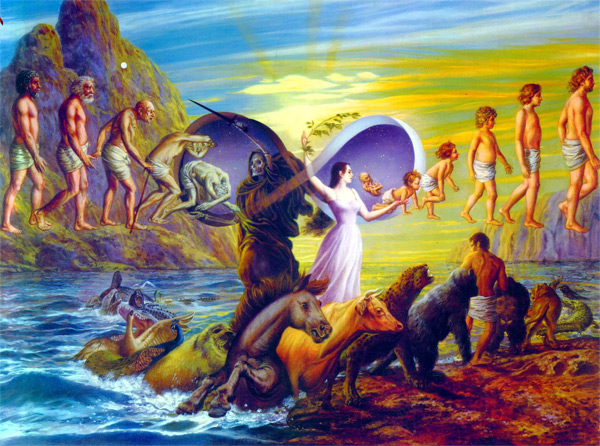
Continued from: "One who has taken birth, he must die."
"... Prabhupāda: Śrotavyādiṣu yaḥ paraḥ. Now we have got to hear so many things. Now what we are doing in this world, in big Delhi city? In the morning we get a bunch of paper to hear about so many advertisements, so many political struggle, and so many things, all useless waste of time. But in our country it is how many pages newspaper nowadays? But in the Western countries, oh, such huge, a big bag. You see? So many, you see? So there are so many things to hear. They are nonsense. Therefore we say śrotavyādiṣu yaḥ paraḥ. This is the... Now, if there had been some political meeting, oh, many hundreds of people would have come to hear. But because we are talking of Kṛṣṇa, nobody is here.
Although it is the śrotavyādiṣu yaḥ paraḥ, it is the supreme subject matter to hear. This is the position. This is the position of the material world. They have lost interest even to hear about the transcendental life, what is this life, what is next life, how we can improve, how, where we are going. Nothing. Simply like cats and dogs they are working hard. Therefore śāstra says, nāyaṁ deho deha-bhājāṁ nṛloke kaṣṭān kāmān arhate viḍ-bhujāṁ ye [SB 5.5.1]. Viḍ-bhujām. Viḍ-bhujāṁ ye. Viḍ-bhujām. Viḍ-bhujām means the hogs, the pigs who are eating stool. They are also working very hard for finding out the stool, "Where there is stool? Where there is stool? Where there is stool?"
So Ṛṣabhadeva warned, "My dear sons, this life, this human form of life, is not meant for working so hard simply for eating, sleeping, mating and defending." Then what it is meant for? Tapo divyaṁ putrakā yena śuddhyet [SB 5.5.1]. "My dear boys, just try to become austere. Just tapasya." Tapasya means voluntarily accepting some difficulties. Not difficulties. Just like in our Society we say, "No illicit sex life, no intoxication, no meat-eating, no gambling." But in the Western countries, these things are daily affair. But they have given up. But they have not..., have died. All these boys and girls who have taken up Kṛṣṇa consciousness movement, they have given up. No illicit sex life, no meat-eating, no intoxication. They do not drink even tea, coffee. They do not smoke even cigarette. This is tapasya, little tapasya. [break]
Everything is there. But we have become so unfortunate, led by rascal and fools leaders, that we are missing the opportunity of this human form of life where we can solve all the problems of life, and the indications are there, here in Śrīmad-Bhāgavatam, Bhagavad-gītā. Therefore Caitanya Mahāprabhu's mission is yāre dekha tāre kaha kṛṣṇa-upadeśa [Cc. Madhya 7.128]. This is Caitanya Mahāprabhu's mission, that āmāra ājñāya guru hañā tāra' ei deśa, yāre dekha tāre kaha kṛṣṇa-upadeśa. This is Caitanya Mahāprabhu's mission, that "I give you order. You, every one of you become a spiritual master." "Oh, I have no qualification. How can I become spiritual master? It requires high knowledge, Sanskrit understanding." "No, you don't require anything. Simply you speak kṛṣṇa-upadeśa."
What is kṛṣṇa-upadeśa? Kṛṣṇa says, sarva-dharmān parityajya mām ekaṁ śaraṇaṁ vraja [Bg. 18.66]. You simply go door to door and say, "Please surrender to Kṛṣṇa." Then you are spiritual master. I have done this. What I have done? I have gone to your country to say this thing, that "Here is Kṛṣṇa, the Supreme Personality of Godhead. You surrender; you become perfect." That is being done.
So it is not very difficult to become spiritual master. Simply you have to become very serious and sincere to the service of Kṛṣṇa. Therefore Śukadeva Gosvāmī, varīyān eṣa te praśnaḥ: [SB 2.1.1] "Oh, it is very nice." Loka-hitam: "It will be beneficial to the whole human society."
Thank you very much. Hare Kṛṣṇa. (end)
Lectures By His Divine Grace A.C. Bhaktivedanta Swami Śrīla Prabhupāda
—
Śrīmad-Bhāgavatam 2.1.1
—
Delhi, November 4, 1973
Translation: "Śrī Śukadeva Gosvāmī said: My dear King, your question is glorious because it is very beneficial to all kinds of people. To hear the answer to this question is the prime subject matter for hearing, and it is approved by all transcendentalists."
Prabhupāda: So Śukadeva Gosvāmī arrived at the point of death of Mahārāja Parīkṣit. Mahārāja Parīkṣit was cursed by a brāhmaṇa boy that he would die within seven days, bitten by a snake. Just imagine how the brahminical culture was so powerful that even a boy born in a brāhmaṇa family... He was only ten or twelve years old... When he heard that his father was insulted by Mahārāja Parīkṣit by garlanding him with a dead snake... His playmates informed him that "Your father has been insulted in this way." So he retaliated that "Within seven days this snake will bite the king and he will die."
So when it was fixed up... Mahārāja Parīkṣit was also very powerful. He could retaliate the brāhmaṇa'scursing, but he did not do it. He accepted, "Yes."
Therefore Lord Śiva said, nārāyaṇa-parāḥ sarve na kutaścana bibhyati: [SB 6.17.28] "When one is devotee of Nārāyaṇa, he is not afraid of anything." Nārāyaṇa-parāḥ sarve na kutaścana bibhyati. He was cursed that "Within the seven days you'll die." So he was not afraid. "That's all right." So he prepared himself, and many learned scholar, saintly person, kings, even demigods, all approached because he was the emperor of the world, and he was going to die. So many big, big stalwart people... Even Vyāsadeva, he was present there. And Parīkṣit Mahārāja said, "Now what is my duty? You are all big men, present here. I am going to die. Now what is my duty?"
This is very important question, that... We are working very hard in this material world, but we are not preparing ourself for death, which is a "must" fact. Everyone must die. The modern civilization, they are afraid of death, but they do not know how to counteract death. This is the modern civilization. But there is process. In the Bhagavad-gītā Kṛṣṇa informs us that our real problem of life is death—birth, death, old age and disease. Birth is the beginning and then, one who has taken birth, he must die. Yāvat, yāvaj jananaṁ tāvan maraṇam.But if one does not take birth, then he does not die. This is the actual problem. Why we have to take birth? People do not know even that there is again life after death. And Bhagavad-gītā's first instruction is tathā dehāntara-prāptiḥ.
dehino 'smin yathā dehe
kaumāraṁ yauvanaṁ jarā
tathā dehāntara-prāptiḥ...
[Bg. 2.13]
As we are changing our body in this life from childhood to boyhood, boyhood to youthhood, then old man, then we give up this body, Kṛṣṇa says that similarly, as I was a child, now I have got a different body, similarly, when I give up this body, I'll get another body. Tathā dehāntara-prāptiḥ.
The people do not even know that there is dehāntara-prāptiḥ, again we have to accept another body.
They do not care for it. And there are so many varieties of body. Just like if we are sitting here, so many ladies and gentlemen, each one of us has got a different type of body. Nobody's body is similar exactly to the other body. This is a fact. We can see. So why we have got different types of body? That we do not try to understand. Not only human body, but there are other bodies also. Jalajā nava-lakṣāṇi sthāvarā lakṣa-viṁśati. We have got bodies in the water, we have got bodies on the land, the tree life, the plant life, the insect life, the birds' life, the beast life, the human form of life... Amongst the human beings there are different varieties—some American, some Indians, some others. So why they are different bodies? What is that science? Why there are different types of bodies?
The different type of body is due to our different karma and different mentality. That we do not know. But Parīkṣit Mahārāja, although he is king... Nowadays the king and president, they are sure that "I am Prime Minister" and "I am President. My position is secure," because he is prime minister. This is the difficulty. The big, big men, they think that "My position is secure," "I am prime minister," "I am Rahis," "I am Birla," "I am big man, so my position is secure."
But Parīkṣit Mahārāja did not think like that. Although he was the emperor, most powerful king, Parīkṣit Mahārāja, he did not think that "I am secure. Because I am emperor of the world, I am secure." No. He immediately become alert: "Oh, I will have to die within seven days. So I must prepare." This is the problem. We do not know whether we are going to die within seven seconds, because there is no guarantee, whereas Parīkṣit Mahārāja had at least seven days' guarantee that he will die after seven days. But so far we are concerned, we can go on the street. There may be any accident. I can die immediately. There are, so many deaths are taking place. The death is sure, and when it will take place, that nobody knows.
Therefore we should take lesson from Mahārāja Parīkṣit that what we are going to prepare for our next life. That is human life. Otherwise it is animal life. The cats and dog, they do not know "What is my next life." They think that... They do not know anything. So if a human being does not know, "What I am preparing for the next life?" he is no better than cats and dogs. That is the statement of the śāstra. It is not my statement.
yasyātma-buddhiḥ kuṇape tri-dhātuke
sva-dhīḥ kalatrādiṣu bhauma ijya-dhīḥ
yat-tīrtha-buddhiḥ salile na karhicij
janeṣv abhijñeṣu sa eva go-kharaḥ
[SB 10.84.13]
Go-kharaḥ. Go means cows and khara means ass. So anyone who has got this concept that "I am this body," "I am Indian," "I am American," "I am brāhmaṇa," "I am kṣatriya," "I am black," "I am white," "I am fat," "I am thin," "I am this," "I am that," this is ātma-buddhi, dehātma-buddhi. Yasyātma-buddhi... One should know that "I am not this body." That is real knowledge. That is real knowledge. But nobody knows that. Everyone thinking. The fighting is going on all over the world. Just like Israel and the, what other the party?
Devotee: Arabs.
Prabhupāda: (laughs) They are thinking that they are this body, and they are fighting. And everywhere it is going on: "I am this body." Cats and dogs are fighting. So actually, we are not this body. That is knowledge. Therefore Bhagavad-gītā begins when Arjuna was thinking in terms of his body that he was declining to fight in terms of body. "Kṛṣṇa, they are my family members, my brothers, my grandfather, my nephews. How can I kill them?" So therefore Kṛṣṇa, when Arjuna accepted Kṛṣṇa as his spiritual master... Śiṣyas te 'haṁ śādhi māṁ prapannam: [Bg. 2.7] "Kṛṣṇa, now we are talking like friends, but that will not make a solution, because friendly talking useless waste of time. Let us talk seriously. So I accept You as my spiritual master." Śiṣyas te 'haṁ śādhi māṁ prapannam. "Now you teach me."
So this is the process of taking lessons. Just like Mahārāja Parīkṣit also trying to take lesson from the learned saintly persons there. At last it was settled that "Whatever Śukadeva Gosvāmī will say, that will be accepted. That will be accepted." So therefore Śukadeva, after being questioned by Mahārāja Parīkṣit, Śukadeva Gosvāmī is answering, varīyān eṣa te praśnaḥ [SB 2.1.1]. He inquired. Parīkṣit Mahārāja inquired. He was a devotee of Lord Kṛṣṇa from the very beginning. Because Pāṇḍava family, they were all Kṛṣṇa's devotee, so Parīkṣit Mahārāja also was a devotee from his childhood. He was worshiping the Deity of Kṛṣṇa. That was his plaything. Just like Mirabai had kṛṣṇa-mūrti.
So those who are born devotees, their inclination is to... That is mentioned in the Bhagavad-gītā, śucīnāṁ śrīmatāṁ gehe yoga-bhraṣṭo 'bhijāyate [Bg. 6.41]. Devotees, from the childhood, they get chance of worshiping Kṛṣṇa or to become Kṛṣṇa conscious. So Parīkṣit Mahārāja was a devotee of Kṛṣṇa. So he inquired from Śukadeva Gosvāmī, "Whether I shall now fully devote myself in Kṛṣṇa consciousness?" And therefore the answer was from Śukadeva Gosvāmī, varīyān eṣa te praśnaḥ [SB 2.1.1]."Yes, it is very nice, glorious. You are thinking of Kṛṣṇa." Varīyān eṣa te praśnaḥ. Then? …" ((to be continued))
Lectures
—
Śrīmad-Bhāgavatam 2.1.1
—
Delhi, November 4, 1973
Prabhupāda: Yes, designation means falsely identifying that I am this body. Now the soul is in this body. Next time the soul is in another body. So according to the body we are having designations. As soon as we get American body, I think myself American. Next life, if I get a body of a dog, then I think myself dog, designate. According to the body I create my designations. But one has to become free from all designations. That is called liberated stage. This is own constitutional position. That position is eternal servant of God. That is the real position of every living entity. But because at the present moment the living entity is in contact with matter, so according to the material modes of the body, he's identifying himself with this body. That is called material designation. "I am American." "I am Englishman." "I am Hindu." "I am Muslim." "I am this." "I am that." These are all designations.
So real perfection of life is without designations. And that is the real constitutional position. Jīvera svarūpa haya nitya-kṛṣṇa-dāsa [Cc. Madhya 20.108-109]. Actual, position of the living entity (indistinct) So that is the perfection of life. And human life is especially meant for, to come to that transcendental position, without any designations.
Our Kṛṣṇa consciousness movement is for that purpose. One should be always thinking of Kṛṣṇa or God. That position is perfect (indistinct). And if one keeps himself in that designation-less position, always thinking of himself, as part and parcel of God, then next life he goes back home, back to Godhead. Tyaktvā dehaṁ punar janma naiti [Bg. 4.9]. After quitting this body he does not come back again to take another material body. He takes spiritual body, or develops a spiritual body and goes back to home, back to Godhead, which means eternal, blissful life of knowledge our, this Kṛṣṇa consciousness movement is for that purpose.
We are trying to bring all men..., of different dimensions, different divisions, to come to this position, always thinking that I am part and parcel of God. My real position is to serve God. Just like this finger is part and parcel of my body. The business of the finger is to serve the body. So long it is in normal condition, the finger is meant for serving the body. When the finger is painful or in abnormal condition it cannot serve the body. Similarly, the living entity, being part and parcel of God, when we cannot serve God that is his abnormal condition. And when he serves God that is his normal condition. That is designation-less position. That is our program.
Dr. Weir: That's very interesting. To my mind the nearest approach in the Christian religion is the Unitarian position, which I don't know if you studied.
Prabhupāda: Christian religion is practically, from the name it appears-Christian and "Kṛṣṇian". Original word of this "Christ" comes from the Greek word "Christo".
Dr. Weir: Anointed.
Prabhupāda: Yes. This "Christa" is Kṛṣṇa.
Dr. Weir: From the Sanskrit?
Prabhupāda: Yes. Kṛṣṭa is the popular word for Kṛṣṇa. And Kṛṣṇa is always anointed with tilaka. We follow this tilaka, Kṛṣṇa, anointed, with this sandal pulp. So, so far I think, there is some very nearest relationship with this Christian and "Kṛṣṇia". Kṛṣṭa means love, love of Godhead or love. We are preaching also the same philosophy. Try to... Not try. The love of Kṛṣṇa is there in everyone's heart, but it is covered. And being covered, it is misplaced. We are loving our society, loving this body, loving our family, loving our kinsmen, or loving internationally human society. But this love is actually perverted reflection of real love of God. Because the love is not placed in the real place. Therefore we are being frustrated in love. Just like in our country Mahatma Gandhi, he loved his country very much. But at the last moment the countrymen shot him down. He was shot down by his own countrymen. The love was paid by (sic:) shooting him and he lost his life. There are many instances.
Dr. Weir: Socrates, Christ, plenty.
Prabhupāda: Yes. So here the love propensity is being misplaced in this material world. That should be placed in God. Then the love will be perfection. Just like if you pour water on the leaves of the tree or branches of the tree it is simply a waste of time. If you pour water on the root then the effect of pouring water is distributed. Similarly, foodstuff, if you place the foodstuff on your nose, on your eyes or your ears, it is simply wasted. But if you put foodstuff to the mouth in the stomach immediately the energy derived from the foodstuff is distributed throughout the whole body. Similarly, if you love God then your, automatically your love is distributed to everyone, every entity. But if you don't love, if you simply love your country... Just like an Englishman, you love your country; German, he loves his country, but there is fight between the English and the Germans because the love is misplaced. But if the Germans or the Englishmen or the Indians they put their love in God there will be no more fighting. Therefore our philosophy is to educate people how to love God. That is real religion. Sa vai puṁsāṁ paro dharmo yato bhaktir adhokṣaje [SB 1.2.6]. That is first-class religion which teaches the follower how to love God. And as soon he becomes a lover of God... Just like I am Indian, but I have come to western countries to teach love of God. It is not that I am satisfied only in myself that I love God, that's all right. But due to my love to God I love others also, because I am trying to teach them to love God, the same philosophy. So if people take seriously this movement, how to love God, then human society will be first-rate.
(Room Conversation with His Divine Grace A.C. Bhaktivedanta Swami Prabhupāda and Dr. Weir of the Mensa Society — September 5, 1971, London)
(Prt. 3 of an essay entitled "Interpertations of Bhagavad-gita by His Divine Grace A.C. Bhaktivedanta Swami Prabhupada, CLICK HERE FOR PART ONE), you may also Click here for part FOUR)
So, these ordinary men who are influenced by the three modes of Nature can work out a plan of their sensual pleasure, but it is not possible for them to give authentic interpretations of Bhagavad-gītā as it was spoken by the Personality of Godhead to Vivasvān or Arjuna. The whole thing is received in transcendental submissiveness by aural reception, which is not accepted by the mundane wranglers deliberately refusing to approach the bona fide spiritual master who has got the keynote of Bhagavad-gītā. It is therefore stated in the Bhagavad-gītā that one who actually wants to have an access to the essence of Bhagavad-gītā must himself engage in the service of a bona fide spiritual master by full surrender. In that position only, one can make bona fide enquiries regarding the Bhagavad-gītā, and in that posture only, the self-realized spiritual masters impregnate the submissive disciple with the knowledge of Gītā, because they have already seen the Truth of it.
tad viddhi praṇipātena
paripraśnena sevayā
upadekṣyanti te jñānaṁ
jñāninas tattva-darśinaḥ
"Just try to learn the truth by approaching a spiritual master. Inquire from him submissively and render service unto him. The self-realized souls can impart knowledge unto you because they have seen the truth." [Bg. 4.34]
Mental speculationists can manufacture wonderful interpretations of Bhagavad-gītā by an intellectual activity, but such interpretation cannot be accepted as bona fide because that is not transcendental to the mundane senses, neither to the material mind in subtle state. As it is stated in the Bhagavad-gītā, such interpretations depending on the mind and senses are sure to be doomed like a boat on the troubled sea. It is said there:
indriyāṇāṁ hi caratāṁ
yan mano 'nuvidhīyate
tad asya harati prajñāṁ
vāyur nāvam ivāmbhasi
tasmād yasya mahā-bāho
nigṛhītāni sarvaśaḥ
indriyāṇīndriyārthebhyas
tasya prajñā pratiṣṭhitā
yā niśā sarva-bhūtānāṁ
tasyāṁ jāgarti saṁyamī
yasyāṁ jāgrati bhūtāni
sā niśā paśyato muneḥ
āpūryamāṇam acala-pratiṣṭhaṁ
samudram āpaḥ praviśanti yadvat
tadvat kāmā yaṁ praviśanti sarve
sa śāntim āpnoti na kāma-kāmī
vihāya kāmān yaḥ sarvān
pumāṁś carati niḥspṛhaḥ
nirmamo nirahaṅkāraḥ
sa śāntim adhigacchati
eṣā brāhmī sthitiḥ pārtha
naināṁ prāpya vimuhyati
sthitvāsyām anta-kāle 'pi
brahma-nirvāṇam ṛcchati
"As a boat on the water is swept away by a strong wind, even one of the roaming senses on which the mind focuses can carry away a man's intelligence.
Therefore, O mighty-armed, one whose senses are restrained from their objects is certainly of steady intelligence.
What is night for all beings is the time of awakening for the self-controlled; and the time of awakening for all beings is night for the introspective sage.
A person who is not disturbed by the incessant flow of desires—that enter like rivers into the ocean, which is ever being filled but is always still—can alone achieve peace, and not the man who strives to satisfy such desires.
A person who has given up all desires for sense gratification, who lives free from desires, who has given up all sense of proprietorship and is devoid of false ego—he alone can attain real peace.
That is the way of the spiritual and godly life, after attaining which a man is not bewildered. If one is thus situated, even at the hour of death, one can enter into the kingdom of God." [Bg.2.67-72]
By these presents it is not however meant that we shall have to accept somebody who is a professional spiritual master or a social spiritual master. The transcendentalist is one who has known Śrī Kṛṣṇa as He is. Śrī Kṛṣṇa is never the person Who can be conceived by mental or physical adjustment. He can only be known by those who have full surrender unto Him. He cannot be understood by sense perception because He is behind a curtain spread by yogamāyā. Unless that curtain is removed by the process of transcendental loving co-operation with Him, one cannot know Śrī Kṛṣṇa as He is.
nāhaṁ prakāśaḥ sarvasya
yoga-māyā-samāvṛtaḥ
manuṣyāṇāṁ sahasreṣu
kaścid yatati siddhaye
yatatām api siddhānāṁ
kaścin māṁ vetti tattvataḥ
avajānanti māṁ mūḍhā
mānuṣĪṁ tanum āśritam
paraṁ bhāvam ajānanto
mama bhūta-maheśvaram
"I am never manifest to the foolish and unintelligent. For them I am covered by My internal potency." [Bg. 7.25]
"Out of many thousands among men, one may endeavor for perfection, and of those who have achieved perfection, hardly one knows Me in truth." [Bg. 7.3]
"Fools deride Me when I descend in the human form. They do not know My transcendental nature as the Supreme Lord of all that be." [Bg. 9.11]
Śrī Vyasadeva experienced Śrī Bhagavān in the following way (Sanskrit quote).
(Part Two of "Interpertations of Bhagavad-gita" by His Divine Grace A.C. Bhaktivedanta Swami Prabhupada, click here for part one, you may also click here for Part Three)
A transcendental source of knowledge which was coming down in a chain of disciplic succession for millions of years before the battle of Kurukṣetra must have been studied by various scholars of the period, but still, we don't find more than one edition or interpretation of the Bhagavad-gītā as represented by Śrī Arjuna; but during the last two hundred years, we have so many interpretations of Bhagavad-gītā by different speculators. This advancement of speculative activities by different mundaners without any reference to the chain of disciplic succession, are all mala fide interpretations, and spread of such mala fide knowledge on the so-called basis of the Great Book of Knowledge, will do more harm than good to the people.
We find also in the last chapter of the Bhagavad-gītā, that the Personality of Godhead has persistently advised that the essence of Bhagavad-gītā must not be disclosed to a person at any time who has not undergone any disciplinary method of austerity and penances, who is not a devotee of Śrī Kṛṣṇa, who is unwilling to accept the teachings of Bhagavad-gītā and, lastly, one who actually envies Śrī Kṛṣṇa, the Personality of Godhead. The śloka which instructs the above procedure runs as follows:
idaṁ te nātapaskāya
nābhaktāya kadācana
na cāśuśrūṣave vācyam
na ca māṁ yo 'bhyasūyati
"This confidential knowledge may never be explained to those who are not austere, or devoted, or engaged in devotional service, nor to one who is envious of Me." [Bg. 18.67]
So, according to Bhagavad-gītā, the following four classes of readers are incompetent to understand the principle of Bhagavad-gītā, and therefore they are not able to make any bona fide interpretations whatsoever. They are:
1. Ordinary men who have no training in austerity or penance.
2. Those who are not devotees of Godhead but are either mundane workers, mundane philosophers or mundane mystics.
3. Those who do not come in the line of disciplic succession like Vivasvān, Manu, Ikṣvāku, Arjuna, etc.
4. Those who disbelieve Śrī Kṛṣṇa as the Absolute Personality of Godhead.
And, these unlucky four classes of men are described in the Bhagavad-gītā as (a) Narādhamāḥ the lowest class of men, (b) mūḍhāḥ non-intelligent men of society, (c) māyayāpahṛta-jñānā persons who have sufficient mundane education, but they are robbed of essential knowledge by the illusory energy or māyā, and (d) the asuras who disbelieve in the very existence of Godhead. The śloka which describes the above fact runs as follows:
na māṁ duṣkṛtino mūḍhāḥ
prapadyante narādhamāḥ
māyayāpahṛta-jñānā
āsuraṁ bhāvam āśritāḥ
"Those miscreants who are grossly foolish, who are lowest among mankind, whose knowledge is stolen by illusion, and who partake of the atheistic nature of demons do not surrender unto Me." [Bg. 7.15]
These four mala fide classes of men have done tremendous harm to the society by making mala fide interpretations of the Bhagavad-gītā according to their limited sensual perceptions, and the result is that the whole atmosphere has been surcharged with mala fide poisons, which are eating the vital necessities of life. We can very well imagine how this process can do harm if we compare it partially with adulterated foodstuff or adulterated medicines. Foodstuff and medicines are concerned with the material body only, but the knowledge which is administered in the Bhagavad-gītā is concerned with spirit soul. In the very beginning of Bhagavad-gītā, the identity of the material body and the spirit soul has been elaborately explained, and the specific instruction of Bhagavad-gītā has always been stressed for the benefit of the spirit soul. The subject matter of the material body and mind has not been neglected in Bhagavad-gītā, but on the contrary, it has been nicely coordinated with the necessities of the spirit soul; but more importance and attention has been drawn on the subject matter of the spirit soul. Therefore, if we protest so much against spread of adulterated foodstuff and medicines which are concerned with the temporary material body only, we have to protest more vigorously against the spread of adulterated interpretations of Bhagavad-gītā because that concerns to the eternal vital power of the spirit soul.
avināśi tu tad viddhi
yena sarvam idaṁ tatam
"That which pervades the entire body you should know to be indestructible." [Bg. 2.17]
For ordinary class of men, the Bhagavad-gītā has enjoined "śāstra-vidhi", i. e. such men have been advised to follow the instructions as have been enjoined in the authentic scriptures. Because the outlaws who are reluctant to follow the instructions of the scriptures cannot ever be successful in all their attempts, and as such they cannot have any peace and prosperity or be elevated to the spiritual or transcendental plane. It is stated in the Bhagavad-gītā as follows:
yaḥ śāstra-vidhim utsṛjya
vartate kāma-kārataḥ
na sa siddhim avāpnoti
na sukhaṁ na parāṁ gatim
"He who discards scriptural injunctions and acts according to his own whims attains neither perfection, nor happiness, nor the supreme destination." [Bg. 16.23]
Such ordinary men, when they manufacture spiritual procedure of austerity or penances for any such pseudo-spiritualistic method, do so according to the mundane quality they might have acquired in the course of their mundane activities. The mundane qualities being divided into three categories, such pseudo-spiritualistic methods are also divided into three categories, namely sattvic (mode of goodness), rajasic (mode of passion) and tamasic mode of ignorance). This is described as follows in the Bhagavad-gītā, namely, (Ch. 17.1-10):
arjuna uvāca
ye śāstra-vidhim utsṛjya
yajante śraddhayānvitāḥ
teṣāṁ niṣṭhā tu kā kṛṣṇa
sattvam āho rajas tamaḥ
śrī-bhagavān uvāca
tri-vidhā bhavati śraddhā
dehināṁ sā svabhāva-jā
sāttvikī rājasī caiva
tāmasī ceti tāṁ śṛṇu
sattvānurūpā sarvasya
śraddhā bhavati bhārata
śraddhā-mayo 'yaṁ puruṣo
yo yac-chraddhaḥ sa eva saḥ
yajante sāttvikā devān
yakṣa-rakṣāṁsi rājasāḥ
pretān bhūta-gaṇāṁś cānye
yajante tāmasā janāḥ
aśāstra-vihitaṁ ghoraṁ
tapyante ye tapo janāḥ
dambhāhaṅkāra-saṁyuktāḥ
kāma-rāga-balānvitāḥ
karṣayantaḥ śarīra-sthaṁ
bhūta-grāmam acetasaḥ
māṁ caivāntaḥ śarīra-sthaṁ
tān viddhy āsura-niścayān
āhāras tv api sarvasya
tri-vidho bhavati priyaḥ
yajñas tapas tathā dānaṁ
teṣāṁ bhedam imaṁ śṛṇu
āyuḥ-sattva-balārogya-
sukha-prīti-vivardhanāḥ
rasyāḥ snigdhāḥ sthirā hṛdyā
āhārāḥ sāttvika-priyāḥ
kaṭv-amla-lavanāṭy-uṣṇa
tīkṣṇa-rūkṣa-vidāhinaḥ
āhārā rājasasyeṣṭā
duḥkha-śokāmaya-pradāḥ
yāta-yāmaṁ gata-rasaṁ
pūti paryuṣitaṁ ca yat
ucchiṣṭam api cāmedhyaṁ
bhojanaṁ tāmasa-priyam
"Arjuna inquired: O Krsna, what is the situation of those who do not follow the principles of scripture but worship according to their own imagination? Are they in goodness, in passion or in ignorance?
The Supreme Personality of Godhead said: According to the modes of nature acquired by the embodied soul, one's faith can be of three kinds—in goodness, in passion or in ignorance. Now hear about this.
O son of Bhārata, according to one's existence under the various modes of nature, one evolves a particular kind of faith. The living being is said to be of a particular faith according to the modes he has acquired.
Men in the mode of goodness worship the demigods; those in the mode of passion worship the demons; and those in the mode of ignorance worship ghosts and spirits.
Those who undergo severe austerities and penances not recommended in the scriptures, performing them out of pride and egoism, who are impelled by lust and attachment, who are foolish and who torture the material elements of the body as well as the Supersoul dwelling within, are to be known as demons.
Even the food each person prefers is of three kinds, according to the three modes of material nature. The same is true of sacrifices, austerities and charity. Now hear of the distinctions between them.
Foods dear to those in the mode of goodness increase the duration of life, purify one's existence and give strength, health, happiness and satisfaction. Such foods are juicy, fatty, wholesome, and pleasing to the heart.
Foods that are too bitter, too sour, salty, hot, pungent, dry and burning are dear to those in the mode of passion. Such foods cause distress, misery and disease.
Food prepared more than three hours before being eaten, food that is tasteless, decomposed and putrid, and food consisting of remnants and untouchable things is dear to those in the mode of darkness." [Bg. 17.1-10]
(TO BE CONTINUED . . .)
click here for part one
click here for part three
An Essay By His Divine Grace A.C. Bhaktivedanta Swami (circa 1948)
It has become a luxurious fashion of the day, along with the progress of material civilization, that everyone can make his interpretation of the great Indian philosophy called the Bhagavad-gītā. This concise form of Vedic knowledge, known as the Gītopaniṣad, is acknowledged by all sections of transcendental scholars, in India especially, as the cream of all Upaniṣads and that of Vedānta-sūtras also. Scholars and ācāryas like Śrīpāda Śaṅkarācārya and some of his followers also could not leave out this very important book of knowledge, although such scholars of the Māyāvāda school did not acknowledge the bona fides of the Purāṇas. But the interpretation of Śrī Śaṅkarācārya differs from the interpretations of the Vaiṣṇava ācāryas headed by Śrī Ramanujācārya and Madhvācārya. There are innumerable interpretations of the Bhagavad-gītā in the market, and it is certainly a puzzling business to select which of the various interpretations shall be accepted as bona fide and which of them shall be rejected as mala fide.
In order to make a distinction between these two classes of bona fide and mala fide interpretations, we have to make an impartial study of the book, and such unbiased study only will make us able to discern the bona fide from the mala fide.
In this connection, we may first of all try to find out the origin of the Bhagavad-gītā. It is wrong to understand that The Bhagavad-gītā was first spoken in the battlefield of Kurukṣetra as it is a part of the great history of India, namely, the Mahābhārata. We can understand from the talks of Śrī Kṛṣṇa and Arjuna, as it is stated in the Bhagavad-gītā, that long, long before the battle of Kurukṣetra, this philosophy was once spoken by Śrī Kṛṣṇa to Vivasvān (the Sun), and from Vivasvān the knowledge was transferred to Manu, and from Manu it was transferred to King Ikṣvāku. And, in that way of disciplic succession, the knowledge has come down to generations after generations, but in course of time, such disciplic succession broke, and therefore, Śrī Kṛṣṇa again repeated the same yoga or transcendental knowledge to Arjuna. In the beginning of the 4th Chapter of Bhagavad-gītā, this fact is stated as follows:
śrī-bhagavān uvāca
imaṁ vivasvate yogaṁ
proktavān aham avyayam
vivasvān manave prāha
manur ikṣvākave 'bravīt
evaṁ paramparā-prāptam
imaṁ rājarṣayo viduḥ
sa kāleneha mahatā
yogo naṣṭaḥ parantapa
sa evāyaṁ mayā te 'dya
yogaḥ proktaḥ purātanaḥ
bhakto 'si me sakhā ceti
rahasyaṁ hy etad uttamam
"The Personality of Godhead, Lord Śrī Kṛṣṇa, said: I instructed this imperishable science of yoga to the sun-god, Vivasvān, and Vivasvān instructed it to Manu, the father of mankind, and Manu in turn instructed it to Ikṣvāku. This supreme science was thus received through the chain of disciplic succession, and the saintly kings understood it in that way. But in course of time the succession was broken, and therefore the science as it is appears to be lost. That very ancient science of the relationship with the Supreme is today told by Me to you because you are My devotee as well as My friend and can therefore understand the transcendental mystery of this science." [Bg. 4.1-3]
Ṛṣis and kings or the kings who were as good as the ṛṣis is the meaning of the word rājarṣaya, and, as such, every one, whether he was a householder or mendicant, knew Bhagavad-gītā before the battle of Kurukṣetra, or before the period of Mahābhārata, which is calculated to be at least five thousand years before, and as such, how it is hinted that the same knowledge was lost. That transcendental knowledge was lost because there must have been some mala fide interpretations of the knowledge, and such knowledge would do more harm than good to the people. It had to be repeated again by Śrī Kṛṣṇa before a bona fide king, and for this, Arjuna was selected at a critical moment because Śrī Kṛṣṇa acknowledged him to be not only a confidential friend, but also a bona fide devotee at the same time. We have to mark the words especially bhakto 'si etc.
bhakto 'si me sakhā ceti
rahasyaṁ hy etad uttamam
"Because you are My devotee as well as My friend and can therefore understand the transcendental mystery of this science." [Bg. 4.3]
Śrī Kṛṣṇa had many friends and relatives at that time who might have been great scholars also, but He selected Arjuna as the bona fide person to grasp the knowledge of Bhagavad-gītā only because Arjuna was a great devotee of the Lord. It may be concluded therefore that the principle of Bhagavad-gītā can be understood only by personalities like Arjuna, who was a completely surrendered soul to Śrī Kṛṣṇa, and this knowledge (yoga) can be explained only by personalities like Śrī Kṛṣṇa (i. e. His bona fide devotees) or for the matter of that by the Personality of Godhead only.
Under such circumstances, the bona fide interpretations can be given only by those who follow the footprints of Arjuna, or, in other words, one who happens to come in the line of disciplic succession from Śrī Arjuna as it was formerly delivered from Vivasvān to Manu (and Ikṣvāku). That is the first condition of understanding Bhagavad-gītā. And, violations of this condition means breaking of the link of disciplic succession and thereby losing the real purpose of the great philosophy. Beside, Bhagavad-gītā is not a new thesis of speculative philosophy, but it is as old as the Sun is. Nobody can say what is the age of the Sun, neither can anybody calculate the age of Manu. According to authentic śāstras, the age of a Manu is 72 x 4,200,000 years. It is also understood that at the present moment, the Manu who has been referred to in the Bhagavad-gītā has been passing his age on the point of the 28th period, out of the above mentioned 72 periods of 4,200,000 years each, and because Manu was told by Vivasvān, it may be safely calculated that Bhagavad-gītā was spoken once before the battle of Kurukṣetra at least 197,600,000 one hundred ninety-seven million sixty hundreds of thousand years before.
(TO BE CONTINUED . . . , click here for Part Two)
Devotee: Do you know? A scientific explanation of water?
Bali-mardana: H-2-O. Hydrogen, two molecules of hydrogen, one molecule of oxygen.
Prabhupāda: So in anywhere there is water, that formula is applicable?
Bali-mardana: Yes.
Prabhupāda: So, within the dob (coconut) there is water.
Bali-mardana: Yes.
Prabhupāda: So who supplied the chemicals?
Bali-mardana: Within the dob (coconut)?
Prabhupāda: Yes.
Bali-mardana: The chemist. The supreme chemist.
Prabhupāda: So that is our theologist's... What is their explanation?
Bali-mardana: They say the water is from the ground. By the roots, it is drawn up to the dob (coconut).
Prabhupāda: I understand that. But the chemical is being supplied from the root?
Bali-mardana: Yes. Just like when there is no water they say the tree will die.
Prabhupāda: Hm?
Bali-mardana: When there is no rain, the plant life cannot live. So they say that the water is drawn from the root to nourish the plant. [break]
Prabhupāda: ...water is drawn, then the question will be how the water is drawn?
Bali-mardana: Well, each tree has a system of, er, system of like tubes through which the water is drawn up.
Prabhupāda: Then as soon as there is system, system is done by somebody.
Bali-mardana: Hm.
Satsvarūpa: Nature, they say.
Bali-mardana: Nature, mother nature.
Prabhupāda: Yes, then mother nature why does not allow you to draw water from the ground? Then mother nature has got sense.
Sudāmā: Why mother nature doesn't let us draw water?
Prabhupāda: Yes, we cannot draw water.
Bali-mardana: But from the well we can draw water.
Sudāmā: We can find water.
Prabhupāda: No, no.
Satsvarūpa: In the mouth we have to drink it.
Prabhupāda: Not like the tree. Trees are called padapa. Padapa means it draws water from the leg. But why you cannot draw water from the leg, by the leg? Why you draw water by the hand?
Satsvarūpa: Because it's nature's arrangement.
Prabhupāda: That means nature has got sense.
Satsvarūpa: They say that nature has simply the desire to see that the species is propagated.
Prabhupāda: Anyway, when you see nature has arranged like that, just try to understand that the tree is made to draw water from the legs, but you cannot do. You have to draw water from the hand. Why different? As there is discrimination, there is sense. You should... It is nature's, I mean to say, order that, or arrangement that "You shall draw water from the hand, and the tree shall draw from the leg." So as there is different arrangement, there is discretion, why I am allowed to draw water by the hand and the tree is allowed to draw water from the leg.
Bali-mardana: They say that evolution.
Prabhupāda: Whatever it may be, there is discretion. As soon as you say evolution, then evolution means there is also some arrangement that "You shall act like this, and he shall act like this."
Sudāmā: Some people already believe, "Well, we already have so much water." Just like when we sweat, there is already water there. There's no question of drawing it from the... like the trees.
Prabhupāda: Why do you draw water? Why you draw water from other source? If you have got water? If you haven't got water, that's all right. Is that sufficient?
Sudāmā: No.
Prabhupāda: Then?
Satsvarūpa: Their idea of the arrangement is that everything is meant for man, for his exploitation and enjoyment.
Prabhupāda: Eh?
Satsvarūpa: Everything is meant for man's, he's the chief living entity. That's their understanding of the arrangement. The tree may have to do this, but we can drink it another way.
Bali-mardana: Man uses his intelligence.
Prabhupāda: That means there is some superior supervision that "You must do like that. He must do like that." You call it nature. We accept that. We also say... Bhagavān, Kṛṣṇa says, prakṛteḥ kriyamāṇāni guṇaiḥ karmāṇi sarvaśaḥ: [Bg. 3.27] "Everything is being done by the direction of prakṛti, nature." So nature is superior than you. You have to accept. Because you are being directed by nature.
Bali-mardana: Their hope is that they can become superior to nature.
Prabhupāda: That is rascaldom. That is rascaldom. There is the foolishness.
prakṛteḥ kriyamāṇāni
guṇaiḥ sarvaśaḥ
ahaṅkāra-vimūḍhātmā
kartāham iti manyate
[Bg. 3.27]
This rascal, is being dictated by nature, but he's thinking that "I am the Lord."
Bali-mardana: He wants to be the best.
Prabhupāda: Ahaṅkāra-vimūḍhātmā. Vimūḍha, rascaldom, ahaṅkāra, by self-conceit. Falsely he's thinking that "I am doing it." Or "I shall be able to do it, without." This is foolishness, this is rascaldom. (japa) Good morning.
Passers-by: Good morning.
Satsvarūpa: The scientists can give evidence that so much control has been gained. Now we can fly all over the world...
Prabhupāda: Then so much control, that is another thing. But not control. "So much control" means no control. (japa) [break] ...admitted that we are controlled by nature. That you cannot refuse. That is foolishness. Now, next, how nature is working? That is also replied in the Bhagavad-gītā, mayādhyakṣeṇa prakṛtiḥ sūyate sa-carācaram: [Bg. 9.10] "The material nature is working..." Just like we are also taking the advantage of material nature, kṣity-ap-tejaḥ. Here is earth, but we can take this earth and make into brick and make a skyscraper building. So it is not that the earth itself is going to become a skyscraper building. I am living entity; I am utilizing. So nature means these five elements, eight elements. So that has been manipulated by another living entity. Just like the aeroplane is a combination of some matter, but it is being worked out by the manufacturer, by the pilot. Therefore that driver of the aeroplane or the manufacturer of the..., he's superior. So superior to the material nature is Kṛṣṇa. This is the conclusion. [break] ...our position is that we are being controlled by the material nature, and, and nature, material nature, is controlled by Kṛṣṇa. So the sense is that one who is at all sensible, that "After all, the controller is Kṛṣṇa. So why not directly under control of Kṛṣṇa?" This is Kṛṣṇa consciousness. Why through the material nature? I have to be controlled. I am being controlled by the material nature; and material nature is being controlled by Kṛṣṇa. So why not being directly controlled? This is good sense.
Prabhupāda: So I have seen this instrument. Destiny is very strong. Karmaṇā daiva-netreṇa jantur deha upapattaye [SB 3.31.1]. Therefore śāstra says that you try for that thing which was not possible in many other lives. In each life everyone gets father, mother, son, and the father's duty to son, son, that is going on. When you take birth as demigod-Indra, Candra, Varuṇa—or as human being or as animal the care-taking business is there. Even the small ant during rainy season, when there is so much flood, they take the eggs on the head—you have seen the red ant?—and finding out some place. The care-taking is there. Even the birds, a sparrow. So when their, the season for laying down eggs, they bring some straws, and keep like that to make a nest for taking care of the eggs. So this taking care by the father and mother, beginning from the ant up to the Indra, Candra devas, that is there.
yas tv indragopam athavendram aho sva-karma-
bandhānurūpa-phala-bhājanam ātanoti
karmāṇi nirdahati kintu ca bhakti-bhājāṁ
govindam ādi-puruṣaṁ tam ahaṁ bhajāmi
[Bs. 5.54]
Indra, there is indragopam, one very small insect. It is also called indra, indragopam, insect. And another Indra is the King of heaven. So śāstra says from this Indra to that indra, everyone is bound up by his karma. It includes all others, from this indra to that Indra. Karmāṇi nirdahati kintu ca bhakti-bhājām [Bs. 5.54]. Everyone is bound up by the resultant action of his karma. It cannot be changed. So śāstra says don't try to change your karma-phala. Better utilize that energy for becoming advanced in Kṛṣṇa consciousness. Because you cannot change the destiny. That is not possible. Then shall I not endeavor for improvement of my economic, economic position? No. Why? I am, because destiny, whatever you have got your destiny, you'll get it. How shall I get it? Now suppose if you are put into some unwanted circumstances. You do not want it. You are forced to accept it. So similarly, as distressed condition comes upon you without your wanting, similarly, the position of happiness also will come to you, even you don't have to try for it. Tal labhyate duḥkhavad anyataḥ sukham. Just like distressed condition, unhappiness, nobody wants, but it comes, by force. Similarly, the conditional happiness of life. Because everyone's life is mixed up with some distress or happiness. Nobody can say, "I am simply happy.'' That is not possible. Distress is there, but nobody wants distress. But it comes. So why happiness will not come? So don't waste your time in this way, because you cannot change this. This will come, automatically. You try for Kṛṣṇa consciousness, which you never tried. That is recommended. And there is a Bengali verse, janame janame sabe pitā mātā pāya: to take care of oneself by the fathers, that is available in every life. Because the ant is also taking care. That is not human society, but he's still taking care. The tiger also taking care. The small cubs, they're loitering on the, on the body of the lion, and he is feeling very nice. Even monkeys, I have seen. One monkey came in window, and she had one small child, and somehow or other the child came inside my room. She, that outside monkey, became mad after it. So I had to take... (laughs) The affection is there. The ant, they're affectionate, the snake affectionate, tiger affectionate, man is affectionate. That is given; otherwise who will take care? So therefore the Vaiṣṇava kavi says, janame janame sabe pitā mātā pāya: in every life you'll get father and mother and their protection, kṛṣṇe guru nahi mile bhaja hari ei, but in every life you cannot get Kṛṣṇa and guru take care of. Because unless you get Kṛṣṇa and guru, then you are within the cycle of birth and death. And you get father and mother and their care, that is all right, but kṛṣṇa-guru does not come in that way. That you have to search out. Ei rūpe brahmāṇḍa brahmite kona bhāgyavān jīva guru-kṛṣṇa-kṛpāya pāya bhakti... [Cc. Madhya 19.151]. Because Kṛṣṇa, guru will give you the nucleus of devotional life. Kṛṣṇa guru nahi mile bhaja hari ei.
So actually, that is the fact, and I was going to tell about Śrīdhara Swami. Śrīdhara Swami was a great devotee, so he was thinking of taking sannyāsa. So he was contemplating that "I shall now leave my home and take sannyāsa.'' So in the meantime, his wife became pregnant. Then he thought that "I was thinking like that. Anyway, this has happened, and if I take sannyāsa now, what people will say, that 'His wife is pregnant and he has taken sannyāsa, he has gone out of home.' " So he waited, the child was born, and the mother died. (laughing) Then he thought, "I do not know what Kṛṣṇa desires. Who will take care of this child, motherless child?'' So that he was thinking very deeply. One lizard dropped before him, one small child lizard. Mother gave birth to a child this morning, and the small lizard was staying, and immediately small ant came before the mouth of that small lizard, and he ate. Then Śrīdhara Swami thought, "The every arrangement is there. Why I am thinking of this or that?'' Immediately went away. Actually, that is the position. The actual care is taken by Kṛṣṇa, eko yo bahūnāṁ vidadhāti kāmān, nityo nityānāṁ cetanaś cetanānām (Kaṭha Upaniṣad 2.2.13). He is taking care of everyone.
So destiny is that we should devote our life for awakening Kṛṣṇa consciousness. This human life is meant for that purpose. By nature's way, prakṛteḥ kriyamāṇāni guṇaiḥ karmāṇi sarvaśaḥ [Bg. 3.27], nature is bringing us. As soon as we become sinful, we are dropped down to suffer the sequence of sinful life in different varieties. Again, just like a man, criminal, is put into the jail, but when his time is finished, again he is made free. Similarly, the cycle of birth and death, dehāntara-prāptiḥ, tathā dehāntara-prāptiḥ [Bg. 2.13], one after another, is going on. So the animal life means reaction of sinful life, and upper class of life, demigods, means result of pious life. Two kinds of things are there, sinful and pious, through the cycle of birth is going on. But this human form of life or above human form of life, it is a chance for understanding the real value of life, and therefore for human beings there are guidances, these Vedas, Purāṇas, Vedānta-sūtra. It is meant for the human beings, not for the cats and dogs. Anādi-bahirmukha jīva kṛṣṇa bhuli gela ataeva kṛṣṇa veda-purāṇa kaila [Cc. Madhya 20.117]. So it is recommended in the human form of life, first of all training as a brahmacārī, then he may remain as gṛhastha for sometime. The life is divided into four parts, twenty-five years. Suppose I live a hundred years: twenty-five years to become brahmacārī, remain as brahmacārī, and twenty-five years to remain as gṛhastha, family man, and twenty-five years as vānaprastha and twenty-five years as sannyāsa. This is system, Vedic system. Sannyāsa means vānaprastha is the prepāration for sannyāsa, and sannyāsa means completely dedicated to the service of Kṛṣṇa. This is our system. Just like you are spirit soul. Our business is not here. Our business in the spiritual world. Here, by circumstances you have fallen into the material condition, but if you take "This is all-in-all our duty,'' that is not advised in the śāstra. It is circumstances. We have fallen into, under certain circumstances, so we have to take care of. The real duty is to how to save myself from this material entanglement.
So our, this institution, that is our ambition, that we are giving, trying to give facilities, at least to some intending person, especially retired person, to take advantage of this institution. As far as possible live, for we have got rooms like that. Live there and take little prasādam and fully devote time how to advance in Kṛṣṇa consciousness. That is success of life. So it is authorized by the śāstras, pañcāś ordhvaṁ vanaṁ vrajet. Therefore you'll find still. But now the things have changed that every holy places there are so many men retired. [break]
Pradyumna: (chanting Sanskrit to Bhagavad-gītā 1.28) [break]
Prabhupāda: "...with my family member shall come to fight with me, so what shall I say, that I have to kill my nephew, I have to kill my brother, I have to kill my grandfather, this is the fight? No, no I am not going to fight. Let them all fight." That is natural. So read it.
Pradyumna:
vepathuś ca śarīre me
roma-harṣaś ca jāyate
gāṇḍīvaṁ sraṁsate hastāt
tvak caiva paridahyate
[Bg. 1.29]
Prabhupāda: "So how can I kill my brother and nephew and others, family members? So my bow is dropping." Go on.
Pradyumna:
na ca śaknomy avasthātuṁ
brahmatīva ca me manaḥ
nimittāni ca paśyāmi
viparītāni keśava
[Bg. 1.30]
Prabhupāda: Yes, viparītāni. "I came to fight, to gain my kingdom, but I see the opposite." Viparītāni. "I'll not be able to enjoy my kingdom by killing them." (indistinct) Go on.
Pradyumna: Ah, translation?
Prabhupāda: No, no. You can go on.
Pradyumna:
na ca śreyo 'nupaśyāmi
hatvā sva-janam āhave
na kāṅkṣe vijayaṁ kṛṣṇa
na ca rājyaṁ sukhāni ca
[Bg. 1.31]
Prabhupāda: Translation.
Pradyumna: "I do not see how any good can come from killing my own kinsmen in this battle, nor can I, my dear Kṛṣṇa, desire any subsequent victory, kingdom or happiness."
Prabhupāda: Naturally this will be. Then?
Pradyumna:
kiṁ no rājyena govinda
kiṁ bhogair jīvitena vā
yeṣām arthe kāṅkṣitaṁ no
rājyaṁ bhogāḥ sukhāni ca
[Bg. 1.32]
Prabhupāda: Generally we improve our material condition just to become happy with relatives. When we construct a new house, we invite relatives. So they may come, they will say, "Oh, you have done very nice,'' and he is also pleased, "My relatives, they have seen.'' But "If all the relatives are killed, then how it will be possible for me to enjoy the kingdom?" Yeṣām arthe kāṅkṣitam rājyam.
Pradyumna: Bhogāḥ sukhāni ca.
Prabhupāda: Yes, bhogāḥ sukhāni ca. Then?
Pradyumna: Ta ime 'vasthitā yuddhe.
Prabhupāda: "They, for whom I wanted this kingdom, they are in my path. I have to kill them. So what kind of fight is this?" Then?
Pradyumna:
prāṇāṁs tyaktvā dhanāni ca
ācāryāḥ pitaraḥ putrās
tathaiva ca pitāmahāḥ
mātulāḥ śvaśurāḥ pautrāḥ
śyālāḥ sambandhinas tathā
Prabhupāda: "I have to kill them, all the religious and family members." Then?
Pradyumna: Etān na hantum icchāmi.
Prabhupāda: "I don't like. I don't want this fight." (laughs)
Pradyumna: Ghnato 'pi madhusūdana.
Prabhupāda: "Then let them kill me. I'll tolerate that. But I am not going to kill them." Then?
Pradyumna:
api trailokya-rājyasya
hetoḥ kiṁ nu mahī-kṛte
nihatya dhārtarāṣṭrān naḥ
kā prītiḥ syāj janārdana
[Bg. 1.35]
Prabhupāda: So in this way he decided, or he made a plan, not to kill. From superficial, material point of view, he was very nice gentleman. But Kṛṣṇa actually chastised, kutas tvā kaśmalam idaṁ viṣame samupasthitam, aśocyān anvaśocas tvaṁ prajñā-vādāṁś... [Bg. 2.11]. "You are talking like a very learned man, but you are fool number one.'' This is the instruction of Bhagavad-gītā. And then at last He said that "The most confidential part of knowledge I am telling you," sarva-dharmān parityajya mām e... [Bg. 18.66]. "What I say, you do. That means I am asking you to kill, to do that.'' So he said, kariṣye vacanam, "Yes.'' That is Kṛṣṇa consciousness. "I do not like to do it, but Kṛṣṇa wants me to do, all right." This is Kṛṣṇa consciousness. It is very difficult. (laughing) I do not like to do, but Kṛṣṇa likes to do, I have to do it. This decision is very good. A Kṛṣṇa conscious person, a devotee, is prepared to do anything nonsense for Kṛṣṇa, even in the estimation of ordinary person. People ask me that "You are spreading Kṛṣṇa consciousness and he is, say, encouraging war," because they have got experience of the last two wars in Western country. So when Kṛṣṇa encouraging the war, they do not take it very nicely. They say, "What kind of God He is?" because they have suffered in the war, and then we are presenting a God who is encouraging war. So there was one lawyer, you know, Goldsmith. He helped me, incorporated this...
Devotee: In New York.
Prabhupāda: New York, yes. He was very good friend. So he was asking that "How it is good, Swamiji, that Kṛṣṇa is encouraging war, fight?'' Although Arjuna was making own plan not to fight, Kṛṣṇa took the trouble for instructing him Gītā and then inducing to change his plan: "Go on, fight!''
(A Conversation With His Divine Grace A.C. Bhaktivedanta Swami Prabhupada, February, 1974)