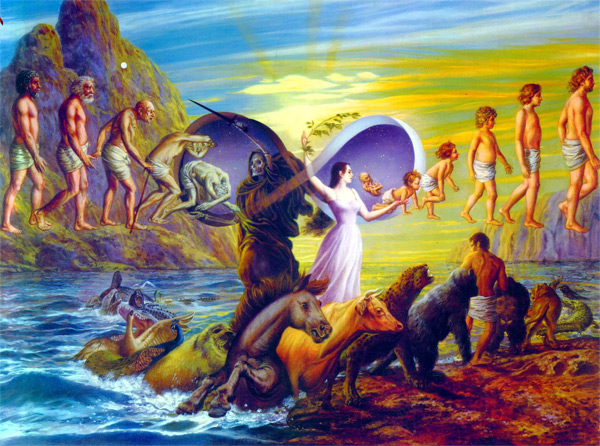
We should not think that the only apprehended culprit is President Nixon and that we are safe. There is a Bengali proverb: "Dry cow dung is used for fuel, and it is said that when the dry cow dung is being burned, the soft cow dung is laughing, saying, 'Oh, you are being burned, but I am safe.' It does not know that when it dries out, it will be thrown into the fire too." We may laugh because President Nixon is in trouble, and we may think ourselves very safe because we have a big bank balance, but actually no one is safe. Eventually everyone will dry up and be thrown in the fire. That is a fact. We may survive for a few years, but we cannot avoid death. In fact, it is said, “As sure as death.” And what is the result of death? One loses everything—all honor, money, position and material life itself. Kṛṣṇa states in Bhagavad-gītā (10.34), mṛtyuḥ sarva-haraś cāham: “I am all-devouring death.” Kṛṣṇa comes as death and plunders everything—bank balance, skyscrapers, wife, children and whatever. One cannot say, “My dear death, please give me some time to adjust.” There is no adjustment; one must immediately get out.
Foolish people are unaware of the miserable conditions of material life. Kṛṣṇa says in Bhagavad-gītā (13.9), janma-mṛtyu jarā-vyādhi-duḥkha-doṣānudarśanam. Real knowledge means knowing that however great one may be, the four principles of material life are present: birth, old age, disease and death. These exist in the highest planetary system (Brahmaloka) and in the lowest (Pātālaloka).
tasyaiva hetoḥ prayateta kovido
na labhyate yad bhramatām upary adhaḥ
tal labhyate duḥkhavad anyataḥ sukhaṁ
kālena sarvatra gabhīra-raṁhasā
“Persons who are actually intelligent and philosophically inclined should endeavor only for that purposeful end which is not obtainable even by wandering from the topmost planet down to the lowest planet. As far as happiness derived from sense enjoyment is concerned, it can be obtained automatically in course of time, just as in course of time we obtain miseries even though we do not desire them.” (Bhāg. 1.5.18)
When Dharmarāja asked Mahārāja Yudhiṣṭhira what the most wonderful thing in the world was, Mahārāja Yudhiṣṭhira replied: ahany ahani bhūtāni gacchantīha yamālayam. “Every moment people are dying, but those who are living are thinking, ‘My friend has died, but I shall live forever.’ ” (Mahābhārata, Vana-parva 313.116) Soft cow dung thinks the same way. This is typical of conditioned beings.
Bhagavān, the Supreme Lord, is not in this position. It is therefore said: bhagavān ātma-māyayā. We come onto this planet to enjoy or suffer life for a few days—fifty or a hundred years—but Bhagavān, the Supreme Personality of Godhead, does not come for that purpose (na māṁ karmāṇi limpanti). It is further stated, na hy asya varṣmaṇaḥ: “No one is greater than Him.” No one is greater than Bhagavān or equal to Him. Everyone is inferior.
According to Caitanya-caritāmṛta (Ādi 5.142), ekale īśvara kṛṣṇa, āra saba bhṛtya. There is only one master—Kṛṣṇa. All others are subservient, beginning with Lord Brahmā, Viṣṇu, Maheśvara, Indra, Candra and all the demigods (there are thirty-three million demigods) and the middle and lower species. Everyone is bhṛtya, or servant. When Kṛṣṇa orders, “My dear Mr. So-and-So, now please give up your place and leave,’, one must go. Therefore everyone is a servant. This is the position of Lord Brahmā and the ant as well. Yas tv indragopam athavendram aho sva-karma [Bs. 5.54]. From Lord Indra to indragopa, an insignificant insect, everyone is reaping the consequences of his karma.
We are creating our own karma, our next body, in this life. In this life we enjoy or suffer the results of our past karma, and in the same way we are creating further karma for our next body. Actually we should work in such a way that we will not get another material body, How can this be done? We simply have to try to understand Kṛṣṇa. As Kṛṣṇa says in Bhagavad-gītā (4.9):
janma karma ca me divyam
evaṁ yo vetti tattvataḥ
tyaktvā dehaṁ punar janma
naiti mām eti so ’rjuna
“One who knows the transcendental nature of My appearance and activities does not, upon leaving the body, take his birth again in this material world, but attains My eternal abode, O Arjuna.”
This sounds very simple, but actually understanding Kṛṣṇa is very difficult. If we become devotees of Kṛṣṇa, understanding Kṛṣṇa is easy. However, if we try to understand Him by jñāna, karma or yoga, we will be frustrated. There are many types of yogīs, but he who is devoted to Kṛṣṇa is the topmost yogī. Śrī Kṛṣṇa is far above all yogic processes. In India there are many yogīs who can display some magical feats. They can walk on water, make themselves very light or very heavy and so forth. But what is this compared to Kṛṣṇa’s yogic mystic powers? By His potencies, great planets are floating in space. Who can manage to float even a small stone in the air? Sometimes a yogī may show a little mystic power by manufacturing some gold, and we are so foolish that we accept him as God. However, we forget that the real yogī, the Supreme Lord Himself, has created millions of gold mines and is floating them in space. Those who are Kṛṣṇa conscious are not befooled by yogīs who claim to be Bhagavān. A Kṛṣṇa conscious person wants only to serve the foremost yogī, Yogeśvara (varimṇaḥ sarva-yoginām). Because we are trying to become His devotees, we accept the Supreme Lord, Yogeśvara, as the Supreme Personality of Godhead. Kṛṣṇa Himself states in Bhagavad-gītā (18.55):
bhaktyā mām abhijānāti
yāvān yaś cāsmi tattvataḥ
tato māṁ tattvato jñātvā
viśate tad-anantaram
“One can understand the Supreme Personality as He is only by devotional service. And when one is in full consciousness of the Supreme Lord by such devotion, he can enter into the kingdom of God.”
This process is actually very simple. One must first of all realize that the first problem is the conquest of death. Presently we consider death compulsory, but actually it is not. One may be put into prison, but actually prison is not compulsory. It is due to one’s work that one becomes a criminal and is therefore put in jail. It is not compulsory for everyone to go to jail. As living entities, we have our proper place in Vaikuṇṭhaloka.
paras tasmāt tu bhāvo ’nyo
’vyakto ’vyaktāt sanātanaḥ
yaḥ sa sarveṣu bhūteṣu
naśyatsu na vinaśyati
avyakto ’kṣara ity uktas
tam āhuḥ paramāṁ gatim
yaṁ prāpya na nivartante
tad dhāma paramaṁ mama
“There is another nature, which is eternal and is transcendental to this manifested and unmanifested matter. It is supreme and is never annihilated. When all in this world is annihilated, that part remains as it is. That supreme abode is called unmanifested and infallible, and it is the supreme destination. When one goes there, he never comes back. That is My supreme abode.” (Bg. 8.20–21)
Everything is present in Vaikuṇṭhaloka. There we can have an eternal, blissful life full of knowledge (sac-cid-ānanda). It is not compulsory for us to rot in this material world. The easiest way to go to the Vaikuṇṭhalokas is: janma karma ca me divyam evaṁ yo vetti tattvataḥ [Bg. 4.9]. Simply try to understand Kṛṣṇa. Why does He come? What are His activities? Where does He come from? Why does He come in the form of a human being? We only have to try to understand this and study Kṛṣṇa as He explains Himself in Bhagavad-gītā. What is the difficulty? God personally explains Himself as He is, and if we accept Bhagavad-gītā as it is, we shall no longer have to transmigrate. Tyaktvā dehaṁ punar janma naiti [Bg. 4.9]. We shall no longer have to endure birth and death, for we can attain our spiritual bodies (sac-cid-ānanda-vigraha [Bs. 5.1]) and live happily in Kṛṣṇa’s family. Kṛṣṇa is providing for us here, and He will also provide for us there. So we should know that our happiness is in returning home, back to Godhead, where we can eat, drink and be merry in Kṛṣṇa’s company. (From Teachings of Queen Kunti By AC Bhaktivedanta Swami Prabhupada)
Translation: "Śrī Śukadeva Gosvāmī said: My dear King, your question is glorious because it is very beneficial to all kinds of people. To hear the answer to this question is the prime subject matter for hearing, and it is approved by all transcendentalists."
Prabhupāda: So Śukadeva Gosvāmī arrived at the point of death of Mahārāja Parīkṣit. Mahārāja Parīkṣit was cursed by a brāhmaṇa boy that he would die within seven days, bitten by a snake. Just imagine how the brahminical culture was so powerful that even a boy born in a brāhmaṇa family... He was only ten or twelve years old... When he heard that his father was insulted by Mahārāja Parīkṣit by garlanding him with a dead snake... His playmates informed him that "Your father has been insulted in this way." So he retaliated that "Within seven days this snake will bite the king and he will die."
So when it was fixed up... Mahārāja Parīkṣit was also very powerful. He could retaliate the brāhmaṇa'scursing, but he did not do it. He accepted, "Yes."
Therefore Lord Śiva said, nārāyaṇa-parāḥ sarve na kutaścana bibhyati: [SB 6.17.28] "When one is devotee of Nārāyaṇa, he is not afraid of anything." Nārāyaṇa-parāḥ sarve na kutaścana bibhyati. He was cursed that "Within the seven days you'll die." So he was not afraid. "That's all right." So he prepared himself, and many learned scholar, saintly person, kings, even demigods, all approached because he was the emperor of the world, and he was going to die. So many big, big stalwart people... Even Vyāsadeva, he was present there. And Parīkṣit Mahārāja said, "Now what is my duty? You are all big men, present here. I am going to die. Now what is my duty?"
This is very important question, that... We are working very hard in this material world, but we are not preparing ourself for death, which is a "must" fact. Everyone must die. The modern civilization, they are afraid of death, but they do not know how to counteract death. This is the modern civilization. But there is process. In the Bhagavad-gītā Kṛṣṇa informs us that our real problem of life is death—birth, death, old age and disease. Birth is the beginning and then, one who has taken birth, he must die. Yāvat, yāvaj jananaṁ tāvan maraṇam.But if one does not take birth, then he does not die. This is the actual problem. Why we have to take birth? People do not know even that there is again life after death. And Bhagavad-gītā's first instruction is tathā dehāntara-prāptiḥ.
dehino 'smin yathā dehe
kaumāraṁ yauvanaṁ jarā
tathā dehāntara-prāptiḥ...
[Bg. 2.13]
As we are changing our body in this life from childhood to boyhood, boyhood to youthhood, then old man, then we give up this body, Kṛṣṇa says that similarly, as I was a child, now I have got a different body, similarly, when I give up this body, I'll get another body. Tathā dehāntara-prāptiḥ.
The people do not even know that there is dehāntara-prāptiḥ, again we have to accept another body.
They do not care for it. And there are so many varieties of body. Just like if we are sitting here, so many ladies and gentlemen, each one of us has got a different type of body. Nobody's body is similar exactly to the other body. This is a fact. We can see. So why we have got different types of body? That we do not try to understand. Not only human body, but there are other bodies also. Jalajā nava-lakṣāṇi sthāvarā lakṣa-viṁśati. We have got bodies in the water, we have got bodies on the land, the tree life, the plant life, the insect life, the birds' life, the beast life, the human form of life... Amongst the human beings there are different varieties—some American, some Indians, some others. So why they are different bodies? What is that science? Why there are different types of bodies?
The different type of body is due to our different karma and different mentality. That we do not know. But Parīkṣit Mahārāja, although he is king... Nowadays the king and president, they are sure that "I am Prime Minister" and "I am President. My position is secure," because he is prime minister. This is the difficulty. The big, big men, they think that "My position is secure," "I am prime minister," "I am Rahis," "I am Birla," "I am big man, so my position is secure."
But Parīkṣit Mahārāja did not think like that. Although he was the emperor, most powerful king, Parīkṣit Mahārāja, he did not think that "I am secure. Because I am emperor of the world, I am secure." No. He immediately become alert: "Oh, I will have to die within seven days. So I must prepare." This is the problem. We do not know whether we are going to die within seven seconds, because there is no guarantee, whereas Parīkṣit Mahārāja had at least seven days' guarantee that he will die after seven days. But so far we are concerned, we can go on the street. There may be any accident. I can die immediately. There are, so many deaths are taking place. The death is sure, and when it will take place, that nobody knows.
Therefore we should take lesson from Mahārāja Parīkṣit that what we are going to prepare for our next life. That is human life. Otherwise it is animal life. The cats and dog, they do not know "What is my next life." They think that... They do not know anything. So if a human being does not know, "What I am preparing for the next life?" he is no better than cats and dogs. That is the statement of the śāstra. It is not my statement.
yasyātma-buddhiḥ kuṇape tri-dhātuke
sva-dhīḥ kalatrādiṣu bhauma ijya-dhīḥ
yat-tīrtha-buddhiḥ salile na karhicij
janeṣv abhijñeṣu sa eva go-kharaḥ
[SB 10.84.13]
Go-kharaḥ. Go means cows and khara means ass. So anyone who has got this concept that "I am this body," "I am Indian," "I am American," "I am brāhmaṇa," "I am kṣatriya," "I am black," "I am white," "I am fat," "I am thin," "I am this," "I am that," this is ātma-buddhi, dehātma-buddhi. Yasyātma-buddhi... One should know that "I am not this body." That is real knowledge. That is real knowledge. But nobody knows that. Everyone thinking. The fighting is going on all over the world. Just like Israel and the, what other the party?
Devotee: Arabs.
Prabhupāda: (laughs) They are thinking that they are this body, and they are fighting. And everywhere it is going on: "I am this body." Cats and dogs are fighting. So actually, we are not this body. That is knowledge. Therefore Bhagavad-gītā begins when Arjuna was thinking in terms of his body that he was declining to fight in terms of body. "Kṛṣṇa, they are my family members, my brothers, my grandfather, my nephews. How can I kill them?" So therefore Kṛṣṇa, when Arjuna accepted Kṛṣṇa as his spiritual master... Śiṣyas te 'haṁ śādhi māṁ prapannam: [Bg. 2.7] "Kṛṣṇa, now we are talking like friends, but that will not make a solution, because friendly talking useless waste of time. Let us talk seriously. So I accept You as my spiritual master." Śiṣyas te 'haṁ śādhi māṁ prapannam. "Now you teach me."
So this is the process of taking lessons. Just like Mahārāja Parīkṣit also trying to take lesson from the learned saintly persons there. At last it was settled that "Whatever Śukadeva Gosvāmī will say, that will be accepted. That will be accepted." So therefore Śukadeva, after being questioned by Mahārāja Parīkṣit, Śukadeva Gosvāmī is answering, varīyān eṣa te praśnaḥ [SB 2.1.1]. He inquired. Parīkṣit Mahārāja inquired. He was a devotee of Lord Kṛṣṇa from the very beginning. Because Pāṇḍava family, they were all Kṛṣṇa's devotee, so Parīkṣit Mahārāja also was a devotee from his childhood. He was worshiping the Deity of Kṛṣṇa. That was his plaything. Just like Mirabai had kṛṣṇa-mūrti.
So those who are born devotees, their inclination is to... That is mentioned in the Bhagavad-gītā, śucīnāṁ śrīmatāṁ gehe yoga-bhraṣṭo 'bhijāyate [Bg. 6.41]. Devotees, from the childhood, they get chance of worshiping Kṛṣṇa or to become Kṛṣṇa conscious. So Parīkṣit Mahārāja was a devotee of Kṛṣṇa. So he inquired from Śukadeva Gosvāmī, "Whether I shall now fully devote myself in Kṛṣṇa consciousness?" And therefore the answer was from Śukadeva Gosvāmī, varīyān eṣa te praśnaḥ [SB 2.1.1]."Yes, it is very nice, glorious. You are thinking of Kṛṣṇa." Varīyān eṣa te praśnaḥ. Then? …" ((to be continued))
Lectures
—
Śrīmad-Bhāgavatam 2.1.1
—
Delhi, November 4, 1973
(Part Four of an essay by His Divine Grace A.C. Bhaktivedanta Swami Prabhupada, Click here for PART ONE)
This param bhāvam or transcendental nature of Śrī Kṛṣṇa, the Absolute Personality of Godhead, is unknowable to the unlucky four classes of men as aforesaid. Some of them who are influenced by asurabhāva or demoniac nature especially consider that Śrī Kṛṣṇa is no better than an ordinary man and the extraordinary qualities that He possessed can be acquired by any ordinary man, or in other words, any one and every one can become a Śrī Kṛṣṇa or more than Him. But the mahātmās who are graced by Śrī Kṛṣṇa know Him otherwise. Such mahātmās know Śrī Kṛṣṇa as the Supreme Personality bhūtamaheśvaram, while the asuras or rakṣasas (like Rāvaṇa and Hiraṇyakaśipu) who defy Śrī Kṛṣṇa as the Supreme Being above everthing and thereby are baffled in their speculative work, frustrated in their hopes, befooled in their search of knowledge thus remain entrapped by the illusory laws of material nature which they are unable to conquer by any amount of speculative method. [margin note: (Nobody is at or above: (aśrama urdhva))] These asuras and mahātmās are definitely distinguished in the Bhagavad-gītā in so many words, as in Chapter 9, Texts 12-14:
moghāśā mogha-karmāṇo
mogha-jñānā vicetasaḥ
rākṣasīm āsurīṁ caiva
prakṛtiṁ mohinīṁ śritāḥ
mahātmānas tu māṁ pārtha
daivīṁ prakṛtim āśritāḥ
bhajanty ananya-manaso
jñātvā bhūtādim avyayam
satataṁ kīrtayanto māṁ
yatantaś ca dṛḍha-vratāḥ
namasyantaś ca māṁ bhaktyā
nitya-yuktā upāsate
"Those who are thus bewildered are attracted by demonic and atheistic views. In that deluded condition, their hopes for liberation, their fruitive activities, and their culture of knowledge are all defeated.
O son of Prtha, those who are not deluded, the great souls, are under the protection of the divine nature. They are fully engaged in devotional service because they know Me as the Supreme Personality of Godhead, original and inexhaustible.
Always chanting My glories, endeavoring with great determination, bowing down before Me, these great souls perpetually worship Me with devotion." [Bg. 9.12-14]
The whole purpose of Bhagavad-gītā is to reveal Śrī Kṛṣṇa the Personality of Godhead as He is. The whole theme of Bhagavad-gītā is to preach the surrendering process of all living beings unto the Lotus feet of Śrī Kṛṣṇa, because all living beings are His parts and parcels, and without this surrendering process, nobody can conquer the indefiable laws of Nature. Material existence of all living beings means a perpetual struggle struggle for existence and a continued fight with Prakriti without any success. [margin note (as done by induction)] Advancement of material science has undoubtedly discovered many weapons by the Asuras to fight with the laws of Nature, but without full surrender unto the Lord Kṛṣṇa, nobody can get relief from such perpetual struggle for existence. The fittest person who shall survive this struggle is one who has completely surrendered unto the Will of Śrī Kṛṣṇa the Personality of Godhead. This fact is stated in the Bhagavad-gītā in the following words:
daivī hy eṣā guṇa-mayī
mama māyā duratyayā
mām eva ye prapadyante
māyām etāṁ taranti te
"This divine energy of Mine, consisting of the three modes of material nature, is difficult to overcome. But those who have surrendered unto Me can easily cross beyond it." [Bg. 7.14]
man-manā bhava mad-bhakto
mad-yājī māṁ namaskuru
mām evaiṣyasi satyaṁ te
pratijāne priyo 'si me
sarva-dharmān parityajya
mām ekaṁ śaraṇaṁ vraja
ahaṁ tvāṁ sarva-pāpebhyo
mokṣayiṣyāmi mā śucaḥ
"Always think of Me, become My devotee, worship Me and offer your homage unto Me. Thus you will come to Me without fail. I promise you this because you are My very dear friend.
"Abandon all varieties of religion and just surrender unto Me. I shall deliver you from all sinful reactions. Do not fear." [Bg. 18.65-66]
ahaṁ sarvasya prabhavo
mattaḥ sarvaṁ pravartate
iti matvā bhajante māṁ
budhā bhāva-samanvitāḥ
mac-cittā mad-gata-prāṇā
bodhayantaḥ parasparam
kathayantaś ca māṁ nityaṁ
tuṣyanti ca ramanti ca
teṣāṁ satata-yuktānāṁ
bhajatāṁ prīti-pūrvakam
dadāmi buddhi-yogaṁ taṁ
yena mām upayānti te
teṣām evānukampārtham
aham ajñāna-jaṁ tamaḥ
nāśayāmy ātma-bhāva-stho
jñāna-dīpena bhāsvatā
"I am the source of all spiritual and material worlds. Everything emanates from Me. The wise who perfectly know this engage in My devotional service and worship Me with all their hearts.
The thoughts of My pure devotees dwell in Me, their lives are fully devoted to My service, and they derive great satisfaction and bliss from always enlightening one another and conversing about Me.
To those who are constantly devoted to serving Me with love, I give the understanding by which they can come to Me.
To show them special mercy, I, dwelling in their hearts, destroy with the shining lamp of knowledge the darkness born of ignorance." [Bg. 10.8-11]
There are certain extraordinarily learned prospective mahātmās who try to understand Śrī Kṛṣṇa by the ascending process of acquiring knowledge, but such process is not only defective, but also troublesome. Such learned scholars attain the Lotus feet of Śrī Kṛṣṇa after many, many births and deaths. Such would-be mahātmās are stated in the Bhagavad-gītā as follows:
bahūnāṁ janmanām ante
jñānavān māṁ prapadyate
vāsudevaḥ sarvam iti
sa mahātmā su-durlabhaḥ
"After many births and deaths, he who is actually in knowledge surrenders unto Me, knowing Me to be the cause of all causes and all that is. Such a great soul is very rare." [Bg. 7.19]
avyaktaṁ vyaktim āpannaṁ
manyante mām abuddhayaḥ
paraṁ bhāvam ajānanto
mamāvyayam anuttamam
"Unintelligent men, who do not know Me perfectly, think that I, the Supreme Personality of Godhead, Kṛṣṇa, was impersonal before and have now assumed this personality. Due to their small knowledge, they do not know My higher nature, which is imperishable and supreme." [Bg. 7.24]
avyakto 'kṣara ity uktas
tam āhuḥ paramāṁ gatim
yaṁ prāpya na nivartante
tad dhāma paramaṁ mama
puruṣaḥ sa paraḥ pārtha
bhaktyā labhyas tv ananyayā
yasyāntaḥ-sthāni bhūtāni
yena sarvam idaṁ tatam
"That which the Vedantists describe as unmanifest and infallible, that which is known as the supreme destination, that place from which, having attained it, one never returns—that is My supreme abode.
The Supreme Personality of Godhead, who is greater than all, is attainable by unalloyed devotion. Although He is present in His abode, He is all-pervading, and everything is situated within Him." [Bg. 8.21-22]
jñāna-yajñena cāpy anye
yajanto mām upāsate
ekatvena pṛthaktvena
bahudhā viśvato-mukham
"Others, who engage in sacrifice by the cultivation of knowledge, worship the Supreme Lord as the one without a second, as diverse in many, and in the universal form." [Bg. 9.15]
kleśo 'dhikataras teṣām
avyaktāsakta-cetasām
avyaktā hi gatir duḥkhaṁ
dehavadbhir avāpyate
ye tu sarvāṇi karmāṇi
mayi sannyasya mat-parāḥ
ananyenaiva yogena
māṁ dhyāyanta upāsate
teṣām ahaṁ samuddhartā
mṛtyu-saṁsāra-sāgarāt
bhavāmi na cirāt pārtha
mayy āveśita-cetasām
"For those whose minds are attached to the unmanifested, impersonal feature of the Supreme, advancement is very troublesome. To make progress in that discipline is always difficult for those who are embodied.
But those who worship Me, giving up all their activities unto Me and being devoted to Me without deviation, engaged in devotinal service and always meditating upon Me, having fixed their minds upon Me, O son of Prtha—for them I am the swift deliverer from the ocean of birth and death." [Bg. 12.5-7]
Preaching of Bhagavad-gītā is not, therefore, a proposition of mental speculation and putting in different mental interpretations of speculative empiric philosphers. It is one without a second concrete fact for the amelioration of the sufferings of humanity especially and animality generally. It must be presented in the bona fide method of spreading the knowledge, strictly in the line of transcendental chain of disciplic succession. Oṁ Tat Sat.
CLICK HERE FOR PART ONE
(Prt. 3 of an essay entitled "Interpertations of Bhagavad-gita by His Divine Grace A.C. Bhaktivedanta Swami Prabhupada, CLICK HERE FOR PART ONE), you may also Click here for part FOUR)
So, these ordinary men who are influenced by the three modes of Nature can work out a plan of their sensual pleasure, but it is not possible for them to give authentic interpretations of Bhagavad-gītā as it was spoken by the Personality of Godhead to Vivasvān or Arjuna. The whole thing is received in transcendental submissiveness by aural reception, which is not accepted by the mundane wranglers deliberately refusing to approach the bona fide spiritual master who has got the keynote of Bhagavad-gītā. It is therefore stated in the Bhagavad-gītā that one who actually wants to have an access to the essence of Bhagavad-gītā must himself engage in the service of a bona fide spiritual master by full surrender. In that position only, one can make bona fide enquiries regarding the Bhagavad-gītā, and in that posture only, the self-realized spiritual masters impregnate the submissive disciple with the knowledge of Gītā, because they have already seen the Truth of it.
tad viddhi praṇipātena
paripraśnena sevayā
upadekṣyanti te jñānaṁ
jñāninas tattva-darśinaḥ
"Just try to learn the truth by approaching a spiritual master. Inquire from him submissively and render service unto him. The self-realized souls can impart knowledge unto you because they have seen the truth." [Bg. 4.34]
Mental speculationists can manufacture wonderful interpretations of Bhagavad-gītā by an intellectual activity, but such interpretation cannot be accepted as bona fide because that is not transcendental to the mundane senses, neither to the material mind in subtle state. As it is stated in the Bhagavad-gītā, such interpretations depending on the mind and senses are sure to be doomed like a boat on the troubled sea. It is said there:
indriyāṇāṁ hi caratāṁ
yan mano 'nuvidhīyate
tad asya harati prajñāṁ
vāyur nāvam ivāmbhasi
tasmād yasya mahā-bāho
nigṛhītāni sarvaśaḥ
indriyāṇīndriyārthebhyas
tasya prajñā pratiṣṭhitā
yā niśā sarva-bhūtānāṁ
tasyāṁ jāgarti saṁyamī
yasyāṁ jāgrati bhūtāni
sā niśā paśyato muneḥ
āpūryamāṇam acala-pratiṣṭhaṁ
samudram āpaḥ praviśanti yadvat
tadvat kāmā yaṁ praviśanti sarve
sa śāntim āpnoti na kāma-kāmī
vihāya kāmān yaḥ sarvān
pumāṁś carati niḥspṛhaḥ
nirmamo nirahaṅkāraḥ
sa śāntim adhigacchati
eṣā brāhmī sthitiḥ pārtha
naināṁ prāpya vimuhyati
sthitvāsyām anta-kāle 'pi
brahma-nirvāṇam ṛcchati
"As a boat on the water is swept away by a strong wind, even one of the roaming senses on which the mind focuses can carry away a man's intelligence.
Therefore, O mighty-armed, one whose senses are restrained from their objects is certainly of steady intelligence.
What is night for all beings is the time of awakening for the self-controlled; and the time of awakening for all beings is night for the introspective sage.
A person who is not disturbed by the incessant flow of desires—that enter like rivers into the ocean, which is ever being filled but is always still—can alone achieve peace, and not the man who strives to satisfy such desires.
A person who has given up all desires for sense gratification, who lives free from desires, who has given up all sense of proprietorship and is devoid of false ego—he alone can attain real peace.
That is the way of the spiritual and godly life, after attaining which a man is not bewildered. If one is thus situated, even at the hour of death, one can enter into the kingdom of God." [Bg.2.67-72]
By these presents it is not however meant that we shall have to accept somebody who is a professional spiritual master or a social spiritual master. The transcendentalist is one who has known Śrī Kṛṣṇa as He is. Śrī Kṛṣṇa is never the person Who can be conceived by mental or physical adjustment. He can only be known by those who have full surrender unto Him. He cannot be understood by sense perception because He is behind a curtain spread by yogamāyā. Unless that curtain is removed by the process of transcendental loving co-operation with Him, one cannot know Śrī Kṛṣṇa as He is.
nāhaṁ prakāśaḥ sarvasya
yoga-māyā-samāvṛtaḥ
manuṣyāṇāṁ sahasreṣu
kaścid yatati siddhaye
yatatām api siddhānāṁ
kaścin māṁ vetti tattvataḥ
avajānanti māṁ mūḍhā
mānuṣĪṁ tanum āśritam
paraṁ bhāvam ajānanto
mama bhūta-maheśvaram
"I am never manifest to the foolish and unintelligent. For them I am covered by My internal potency." [Bg. 7.25]
"Out of many thousands among men, one may endeavor for perfection, and of those who have achieved perfection, hardly one knows Me in truth." [Bg. 7.3]
"Fools deride Me when I descend in the human form. They do not know My transcendental nature as the Supreme Lord of all that be." [Bg. 9.11]
Śrī Vyasadeva experienced Śrī Bhagavān in the following way (Sanskrit quote).
An Essay By His Divine Grace A.C. Bhaktivedanta Swami (circa 1948)
It has become a luxurious fashion of the day, along with the progress of material civilization, that everyone can make his interpretation of the great Indian philosophy called the Bhagavad-gītā. This concise form of Vedic knowledge, known as the Gītopaniṣad, is acknowledged by all sections of transcendental scholars, in India especially, as the cream of all Upaniṣads and that of Vedānta-sūtras also. Scholars and ācāryas like Śrīpāda Śaṅkarācārya and some of his followers also could not leave out this very important book of knowledge, although such scholars of the Māyāvāda school did not acknowledge the bona fides of the Purāṇas. But the interpretation of Śrī Śaṅkarācārya differs from the interpretations of the Vaiṣṇava ācāryas headed by Śrī Ramanujācārya and Madhvācārya. There are innumerable interpretations of the Bhagavad-gītā in the market, and it is certainly a puzzling business to select which of the various interpretations shall be accepted as bona fide and which of them shall be rejected as mala fide.
In order to make a distinction between these two classes of bona fide and mala fide interpretations, we have to make an impartial study of the book, and such unbiased study only will make us able to discern the bona fide from the mala fide.
In this connection, we may first of all try to find out the origin of the Bhagavad-gītā. It is wrong to understand that The Bhagavad-gītā was first spoken in the battlefield of Kurukṣetra as it is a part of the great history of India, namely, the Mahābhārata. We can understand from the talks of Śrī Kṛṣṇa and Arjuna, as it is stated in the Bhagavad-gītā, that long, long before the battle of Kurukṣetra, this philosophy was once spoken by Śrī Kṛṣṇa to Vivasvān (the Sun), and from Vivasvān the knowledge was transferred to Manu, and from Manu it was transferred to King Ikṣvāku. And, in that way of disciplic succession, the knowledge has come down to generations after generations, but in course of time, such disciplic succession broke, and therefore, Śrī Kṛṣṇa again repeated the same yoga or transcendental knowledge to Arjuna. In the beginning of the 4th Chapter of Bhagavad-gītā, this fact is stated as follows:
śrī-bhagavān uvāca
imaṁ vivasvate yogaṁ
proktavān aham avyayam
vivasvān manave prāha
manur ikṣvākave 'bravīt
evaṁ paramparā-prāptam
imaṁ rājarṣayo viduḥ
sa kāleneha mahatā
yogo naṣṭaḥ parantapa
sa evāyaṁ mayā te 'dya
yogaḥ proktaḥ purātanaḥ
bhakto 'si me sakhā ceti
rahasyaṁ hy etad uttamam
"The Personality of Godhead, Lord Śrī Kṛṣṇa, said: I instructed this imperishable science of yoga to the sun-god, Vivasvān, and Vivasvān instructed it to Manu, the father of mankind, and Manu in turn instructed it to Ikṣvāku. This supreme science was thus received through the chain of disciplic succession, and the saintly kings understood it in that way. But in course of time the succession was broken, and therefore the science as it is appears to be lost. That very ancient science of the relationship with the Supreme is today told by Me to you because you are My devotee as well as My friend and can therefore understand the transcendental mystery of this science." [Bg. 4.1-3]
Ṛṣis and kings or the kings who were as good as the ṛṣis is the meaning of the word rājarṣaya, and, as such, every one, whether he was a householder or mendicant, knew Bhagavad-gītā before the battle of Kurukṣetra, or before the period of Mahābhārata, which is calculated to be at least five thousand years before, and as such, how it is hinted that the same knowledge was lost. That transcendental knowledge was lost because there must have been some mala fide interpretations of the knowledge, and such knowledge would do more harm than good to the people. It had to be repeated again by Śrī Kṛṣṇa before a bona fide king, and for this, Arjuna was selected at a critical moment because Śrī Kṛṣṇa acknowledged him to be not only a confidential friend, but also a bona fide devotee at the same time. We have to mark the words especially bhakto 'si etc.
bhakto 'si me sakhā ceti
rahasyaṁ hy etad uttamam
"Because you are My devotee as well as My friend and can therefore understand the transcendental mystery of this science." [Bg. 4.3]
Śrī Kṛṣṇa had many friends and relatives at that time who might have been great scholars also, but He selected Arjuna as the bona fide person to grasp the knowledge of Bhagavad-gītā only because Arjuna was a great devotee of the Lord. It may be concluded therefore that the principle of Bhagavad-gītā can be understood only by personalities like Arjuna, who was a completely surrendered soul to Śrī Kṛṣṇa, and this knowledge (yoga) can be explained only by personalities like Śrī Kṛṣṇa (i. e. His bona fide devotees) or for the matter of that by the Personality of Godhead only.
Under such circumstances, the bona fide interpretations can be given only by those who follow the footprints of Arjuna, or, in other words, one who happens to come in the line of disciplic succession from Śrī Arjuna as it was formerly delivered from Vivasvān to Manu (and Ikṣvāku). That is the first condition of understanding Bhagavad-gītā. And, violations of this condition means breaking of the link of disciplic succession and thereby losing the real purpose of the great philosophy. Beside, Bhagavad-gītā is not a new thesis of speculative philosophy, but it is as old as the Sun is. Nobody can say what is the age of the Sun, neither can anybody calculate the age of Manu. According to authentic śāstras, the age of a Manu is 72 x 4,200,000 years. It is also understood that at the present moment, the Manu who has been referred to in the Bhagavad-gītā has been passing his age on the point of the 28th period, out of the above mentioned 72 periods of 4,200,000 years each, and because Manu was told by Vivasvān, it may be safely calculated that Bhagavad-gītā was spoken once before the battle of Kurukṣetra at least 197,600,000 one hundred ninety-seven million sixty hundreds of thousand years before.
(TO BE CONTINUED . . . , click here for Part Two)