Showing posts with label spirit. Show all posts

Friday, March 17, 2017

Body Death: Goodness, Passion, Ignorance

 
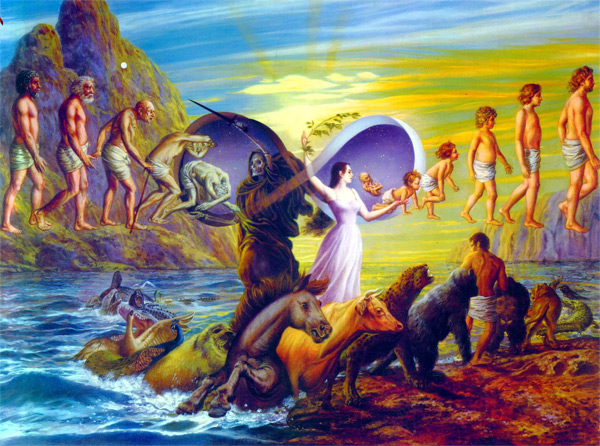
There is yoga, and there is yogamāyā. Yogamāyā means forgetfulness. First of all we have to understand what is the soul. At the present moment, people are in such darkness that they do not even understand the soul. Therefore Bhagavad-gītā first of all teaches what the soul is:
 
“As the embodied soul continually passes in this body from boyhood to youth to old age, the soul similarly passes into another body at death. The self-realized soul is not bewildered by such a change.” 
 
The word dehī means “the proprietor of the body.” We are thinking, “I am this body,” but actually this is not so. We are the proprietors of the body, and that is the real understanding of the self. We do not say, “I am this finger” or “I am this hand.” Rather, we say, “This is my finger, this is my head, this is my leg, etc.” Similarly, the same can be said about the entire body. “This is my body.” This means that I am the proprietor of this body. The body has been given by māyā, the material energy.
 
“The bewildered spirit soul, under the influence of the three modes of material nature, thinks himself to be the doer of activities that are in actuality carried out by nature.” (Bg. 3.27)
 
The living entity receives different types of bodies according to karma. One living entity may receive a cat body, another a dog body, and so forth. Why are there so many different bodies? Why not one kind of body? 
 
The answer to this is also given in Bhagavad-gītā (13.22):
kāraṇaṁ guṇa-saṅgo ’sya
sad-asad-yoni janmasu
“It is due to his association with the modes of material nature. Thus he meets with good and evil among various species.”
 
Because the soul within the body associates with the three modes of material nature (goodness, passion and ignorance), he receives different types of bodies. One doesn’t have to aspire for his next body; one need only rest assured that it will be a different body. 
 
On the other hand, Kṛṣṇa does not say what kind of body one will be awarded. That depends on qualification. If one associates with the mode of goodness, he is elevated to the higher planetary systems. If he associates with the mode of passion, he remains here. And if one associates with the mode of ignorance and darkness, he goes down to lower life forms—animals, trees and plants. This is the proclamation of Śrī Kṛṣṇa in Bhagavad-gītā (14.18):
“Those situated in the mode of goodness gradually go upward to the higher planets; those in the mode of passion live on the earthly planets; and those in the mode of ignorance go down to the hellish worlds.”
 
There are 8,400,000 species of life, and all of these arise from one’s association with the modes of nature (kāraṇaṁ guṇa-saṅgo ’sya). And, according to the body, one undergoes distress and happiness. One cannot expect a dog to enjoy the same happiness that a king or rich man enjoys. Whether one enjoys this or that happiness or suffers this or that distress, both distress and happiness are due to the material body. Yoga means transcending the distress or happiness of the material body. If we connect ourselves with Kṛṣṇa through the supreme yoga, we can get rid of material happiness and distress arising from the body. Reconnecting with Kṛṣṇa is called bhakti-yoga, and Kṛṣṇa comes to instruct us in this supreme yoga. 
 
In essence, He says, “Just revive your connection with Me, you rascal. Give up all these manufactured yogas and religions and just surrender unto Me. That is Kṛṣṇa’s instruction, and Kṛṣṇa’s representative, the incarnation or the guru, says the same thing. Although Kapiladeva is an incarnation of Kṛṣṇa, He acts as the representative of Kṛṣṇa, the guru. If we just accept the principle of surrender unto Kṛṣṇa, we will become actually transcendental to so-called material happiness. We should not be captivated by material happiness or aggrieved by material distress. These are causes for bondage. Material happiness is not actual happiness. It is actually distress. 
 
We try to be happy by obtaining money, but money is not very easily obtained, and we have to undergo a great deal of distress to get it. However, we accept this distress with the hope of getting some false happiness. If we purify our senses, on the other hand, we can come to the spiritual platform. Real happiness lies in engaging our senses to satisfy the senses of Kṛṣṇa. In this way our senses are spiritualized, and this is called ādhyātmika-yoga or bhakti-yoga. This is the yoga that Lord Kapiladeva is herein expounding.
 

Wednesday, January 23, 2013

One who has taken birth, he must die.


Translation: "Śrī Śukadeva Gosvāmī said: My dear King, your question is glorious because it is very beneficial to all kinds of people. To hear the answer to this question is the prime subject matter for hearing, and it is approved by all transcendentalists."

Prabhupāda: So Śukadeva Gosvāmī arrived at the point of death of Mahārāja Parīkṣit. Mahārāja Parīkṣit was cursed by a brāhmaṇa boy that he would die within seven days, bitten by a snake. Just imagine how the brahminical culture was so powerful that even a boy born in a brāhmaṇa family... He was only ten or twelve years old... When he heard that his father was insulted by Mahārāja Parīkṣit by garlanding him with a dead snake... His playmates informed him that "Your father has been insulted in this way." So he retaliated that "Within seven days this snake will bite the king and he will die."

So when it was fixed up... Mahārāja Parīkṣit was also very powerful. He could retaliate the brāhmaṇa'scursing, but he did not do it. He accepted, "Yes."

Therefore Lord Śiva said, nārāyaṇa-parāḥ sarve na kutaścana bibhyati: [SB 6.17.28] "When one is devotee of Nārāyaṇa, he is not afraid of anything." Nārāyaṇa-parāḥ sarve na kutaścana bibhyati. He was cursed that "Within the seven days you'll die." So he was not afraid. "That's all right." So he prepared himself, and many learned scholar, saintly person, kings, even demigods, all approached because he was the emperor of the world, and he was going to die. So many big, big stalwart people... Even Vyāsadeva, he was present there. And Parīkṣit Mahārāja said, "Now what is my duty? You are all big men, present here. I am going to die. Now what is my duty?"

This is very important question, that... We are working very hard in this material world, but we are not preparing ourself for death, which is a "must" fact. Everyone must die. The modern civilization, they are afraid of death, but they do not know how to counteract death. This is the modern civilization. But there is process. In the Bhagavad-gītā Kṛṣṇa informs us that our real problem of life is death—birth, death, old age and disease. Birth is the beginning and then, one who has taken birth, he must die. Yāvat, yāvaj jananaṁ tāvan maraṇam.But if one does not take birth, then he does not die. This is the actual problem. Why we have to take birth? People do not know even that there is again life after death. And Bhagavad-gītā's first instruction is tathā dehāntara-prāptiḥ.

dehino 'smin yathā dehe
kaumāraṁ yauvanaṁ jarā
tathā dehāntara-prāptiḥ...
[Bg. 2.13]

As we are changing our body in this life from childhood to boyhood, boyhood to youthhood, then old man, then we give up this body, Kṛṣṇa says that similarly, as I was a child, now I have got a different body, similarly, when I give up this body, I'll get another body. Tathā dehāntara-prāptiḥ.
The people do not even know that there is dehāntara-prāptiḥ, again we have to accept another body.

They do not care for it. And there are so many varieties of body. Just like if we are sitting here, so many ladies and gentlemen, each one of us has got a different type of body. Nobody's body is similar exactly to the other body. This is a fact. We can see. So why we have got different types of body? That we do not try to understand. Not only human body, but there are other bodies also. Jalajā nava-lakṣāṇi sthāvarā lakṣa-viṁśati. We have got bodies in the water, we have got bodies on the land, the tree life, the plant life, the insect life, the birds' life, the beast life, the human form of life... Amongst the human beings there are different varieties—some American, some Indians, some others. So why they are different bodies? What is that science? Why there are different types of bodies?

The different type of body is due to our different karma and different mentality. That we do not know. But Parīkṣit Mahārāja, although he is king... Nowadays the king and president, they are sure that "I am Prime Minister" and "I am President. My position is secure," because he is prime minister. This is the difficulty. The big, big men, they think that "My position is secure," "I am prime minister," "I am Rahis," "I am Birla," "I am big man, so my position is secure."

But Parīkṣit Mahārāja did not think like that. Although he was the emperor, most powerful king, Parīkṣit Mahārāja, he did not think that "I am secure. Because I am emperor of the world, I am secure." No. He immediately become alert: "Oh, I will have to die within seven days. So I must prepare." This is the problem. We do not know whether we are going to die within seven seconds, because there is no guarantee, whereas Parīkṣit Mahārāja had at least seven days' guarantee that he will die after seven days. But so far we are concerned, we can go on the street. There may be any accident. I can die immediately. There are, so many deaths are taking place. The death is sure, and when it will take place, that nobody knows.

Therefore we should take lesson from Mahārāja Parīkṣit that what we are going to prepare for our next life. That is human life. Otherwise it is animal life. The cats and dog, they do not know "What is my next life." They think that... They do not know anything. So if a human being does not know, "What I am preparing for the next life?" he is no better than cats and dogs. That is the statement of the śāstra. It is not my statement.

yasyātma-buddhiḥ kuṇape tri-dhātuke
sva-dhīḥ kalatrādiṣu bhauma ijya-dhīḥ
yat-tīrtha-buddhiḥ salile na karhicij
janeṣv abhijñeṣu sa eva go-kharaḥ
[SB 10.84.13]

Go-kharaḥ. Go means cows and khara means ass. So anyone who has got this concept that "I am this body," "I am Indian," "I am American," "I am brāhmaṇa," "I am kṣatriya," "I am black," "I am white," "I am fat," "I am thin," "I am this," "I am that," this is ātma-buddhi, dehātma-buddhi. Yasyātma-buddhi... One should know that "I am not this body." That is real knowledge. That is real knowledge. But nobody knows that. Everyone thinking. The fighting is going on all over the world. Just like Israel and the, what other the party?

Devotee: Arabs.

Prabhupāda: (laughs) They are thinking that they are this body, and they are fighting. And everywhere it is going on: "I am this body." Cats and dogs are fighting. So actually, we are not this body. That is knowledge. Therefore Bhagavad-gītā begins when Arjuna was thinking in terms of his body that he was declining to fight in terms of body. "Kṛṣṇa, they are my family members, my brothers, my grandfather, my nephews. How can I kill them?" So therefore Kṛṣṇa, when Arjuna accepted Kṛṣṇa as his spiritual master... Śiṣyas te 'haṁ śādhi māṁ prapannam: [Bg. 2.7] "Kṛṣṇa, now we are talking like friends, but that will not make a solution, because friendly talking useless waste of time. Let us talk seriously. So I accept You as my spiritual master." Śiṣyas te 'haṁ śādhi māṁ prapannam. "Now you teach me."

So this is the process of taking lessons. Just like Mahārāja Parīkṣit also trying to take lesson from the learned saintly persons there. At last it was settled that "Whatever Śukadeva Gosvāmī will say, that will be accepted. That will be accepted." So therefore Śukadeva, after being questioned by Mahārāja Parīkṣit, Śukadeva Gosvāmī is answering, varīyān eṣa te praśnaḥ [SB 2.1.1]. He inquired. Parīkṣit Mahārāja inquired. He was a devotee of Lord Kṛṣṇa from the very beginning. Because Pāṇḍava family, they were all Kṛṣṇa's devotee, so Parīkṣit Mahārāja also was a devotee from his childhood. He was worshiping the Deity of Kṛṣṇa. That was his plaything. Just like Mirabai had kṛṣṇa-mūrti. 

So those who are born devotees, their inclination is to... That is mentioned in the Bhagavad-gītā, śucīnāṁ śrīmatāṁ gehe yoga-bhraṣṭo 'bhijāyate [Bg. 6.41]. Devotees, from the childhood, they get chance of worshiping Kṛṣṇa or to become Kṛṣṇa conscious. So Parīkṣit Mahārāja was a devotee of Kṛṣṇa. So he inquired from Śukadeva Gosvāmī, "Whether I shall now fully devote myself in Kṛṣṇa consciousness?" And therefore the answer was from Śukadeva Gosvāmī, varīyān eṣa te praśnaḥ [SB 2.1.1]."Yes, it is very nice, glorious. You are thinking of Kṛṣṇa." Varīyān eṣa te praśnaḥ. Then? …" ((to be continued))


Lectures

Śrīmad-Bhāgavatam 2.1.1

Delhi, November 4, 1973


Wednesday, September 05, 2012


Man is the Architect of His Own Fortune


 By: His  Divine Grace A.C. Bhaktivedanta Swami Shrila Prabhupada 

[This has been proofread against the original handwritten manuscript with corrections made for Folio.—Ed]

Man is the architect of his own fortune.

Man is the architect of his own fortune. That is an old well known English maxim and the good fortune that the man has evolved out for him at the present moment can be amply verified as soon as we receive our morning newspapers. The sample good news that we are receiving now in every morning are as follows:

(1) Bihar Government Deny starvation death. (A.B.P. 23.45)

(2) Rice selling at 55 and salt at 80/- per (?).

(3) People living on cotton & Potato leaves.

(4) 600 Viet Minh Troops Taken Prisoner.

(5) 500 mounds of food burnt in granary.

(6) Famine conditions in such and such places.

(7) Progressive decontrol urged in Conferences.

(8) Recovery of Abducted women.

(9) (?) on woes of Refugees.

(10) High Government official Arrested.

(11) Government Crisis in Britain.

(12) Troops Patrolling Streets of Cooch Behar

(13) Mob attacks ____'s House and injures son.

(14) Congress Office Raided

(15) Rationing Official Assaulted

(16) Present Administration (?) and compared with past

(17) 30,000 Nepalese migrate to India.

(18) Persian students defy Government Ban.

(19) Mile long procession in Sympathy with Killed oil workers.

(20) Red offensive Imminent.

(21) Principal Garg Killed by examinees

(22) Daring Robbery at Lloyds Bank.

(23) Rs. 12 lakhs taken away.

(24) Baroda Ex-Rulers Submission to President.

Thoughtful men must now seriously think how we are marching towards the progressive way of human civilization. The influence of modern civilizing process, by the highests(?) of planning commissions, is gradually leading us to a destination summarised as follows:

(1) Destruction of Faith, Truthfulness, cleanliness, Forgiveness, Mercy, Longevity, Strength and Memory.

(2) Accumulation of vast wealth is the standard of recognition for one's parentage, behavior and good qualities.

(3) Black-market in every business deal.

(4) Sexuality in conjugal love.

(5) Only a piece of thread on the body marks the sign of Brahmanism.

(6) Only a red garment as the sign of a sannyṛsî.

(7) No justice in the law Court without money.

(8) Impartinance as the sign of education.

(9) Poverty means dishonesty.

(10) Pride means honesty.

(11) Acceptance by contract means marriage.

(12) Keeping long hairs means beauty.

(13) Exaggeration means truthfulness.

(14) Filling the stomach means self-realization.

(15) Providing the wife & children means ability.

(16) Religiosity means to acquire some extraordinary name & fame.

When we have produced such a glorious sample of human civilization, certainly democracy will mean nothing but accumulating a large number of votes by hook or crook and then capture the political power. As a result of such unruly(unholy?) election heads of political power, will be by nature merciless, greedy and bestowed with the qualities of the plunderers. The unfortunate voters who have not much discriminating power as victimized by the chain of modern civilizing process become subjected to the plundering process of the political heads in the matter of their hearth and home.

These unfortunate people being too much harrassed by governmental taxes and famine, are forced to accept cotton and potato or other leaves as foodstuff. They become forced to accept meat and flesh instead of grains and vegetables and they are obliged to assimilate hydrogenated injurious oil in place milk and ghee. By such eating process they are attacked with cholera, typhoid, dysentry and tuberculosis to meet an end of miserable life.

They are subjected to the pangs of winter and summer, rains and sun besides hunger, thirst, disappointment, frustration. Thus they have to make a sad end of life by over anxiety due to all round scarcity.

That is the sum and substance of the advancement of material civilization. Undoubtedly we have produced by dint of advancement of having the motors, the radios, the cinemas, the railways, the airways, the (? ), the medicines, the toilets, the big buildings, the big mills, agricultural implements, big offices, (?), hodgepodge philosophers, industrialists, poets, scientists, politicians, iron men, statesmen and what not but the net result is no food, no clothing, no shelter, no peace.

Will any thinking and sober man with any sense of human reasoning call this status of human life as civilized? We think not. This unrestricted material progress of civilization must be checked if humanity has to exist at all and the big brains who pose to lead the people in general must now try to understand and recognise that matter is not all in all but it is subordinate to the spirit.

The matter is produced of inferior nature while the spirit is born of a superior nature. The living being whatever it may be is the particle of that spirit qualitatively one & equal with the Supreme Spirit. The living entities are parts & parcels of the Supreme Spirit. The ideology of material civilization must be changed into the ideology of spiritual civilization. Material civilization is based on the ideology of unsatiable desire for sense gratification which leads to anger when such sense gratification remains unsatisfied and from anger it turns to bewilderment which again turns into loss of memory. This loss of memory is complete destruction of spiritual consciousness which is the highest type of ignorance.

Leaders of material ideology came and gone after having enjoyed this material earth for a limited period. The material bodies of such leaders of ideology under various big big names are now turned into worms, stools or ashes and such materialistic leaders who fought so much on their different ideologies did not know what should be permanent basis of civilization. Most of them have gone to the lowest status of the kingdom of hell due to their unholy action of public nuisance. Such leader falsely thinks that this material world is now enjoyed by him and afterwards it shall be enjoyed by his generations without knowing what he is and what are his (?). Such false sense of proprietorship arises out of (?) ignorance by loss of memory of spiritual consciousness.

By falsely accepting this material body as the real self the foolish people engage themselves in the gross materialistic activities resulting in the conditions mentioned above but later on he goes away under the laws of higher authority leaving both the material world and material body behind them. They leave behind only a historical narration of their transient life without any (?) tangible benefit for the human being. The mother earth when the leaders and kings wanted to exploit laughs at these leaders and kings when she sees that the leaders and kings cannot go away but the earth remains where she is.

Dr. S.P. Mookerjee rightly observed in his address at Sri Aurobindo Memorial Convention (dated 24.4.51) as follows: "These spiritual efforts of the great master often defy common understanding. Yet the call of the times was never so imperious at it is now. What India is suffering from today is not so much poverty of the means of material existence. She is suffering much more from the bankruptcy of her spiritual resources. Her spirit has stooped low and is even now stooping low—not to conquer but to encompass a moral tragedy too terrible to contemplate.

"The Government moves in the same vicious circle. Moral standards are at discount. High purpose is resumed exclusively as an adornment of pontifical pronouncement from high offices. The same(?) is virtually littered with the debris of the spiritual achievements of a people that was once great."


Essays and Articles
EA 9: Man is the Architect of His Own Fortune